From the earliest civilizations along its rivers to a dynamic nation in the 21st century, Vietnam’s history is a story of resilience, adaptation, cultural identity, and an enduring aspiration for the future.
Some nations are remembered through vast empires, monumental achievements, or conquests that reshaped the map of the world.
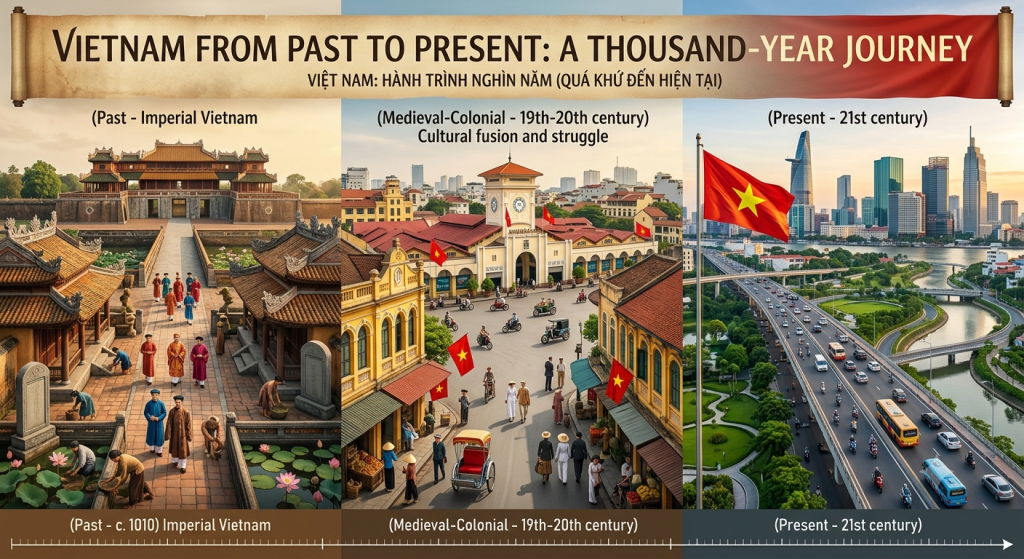
Vietnam is remembered in a different way.
It is a country situated at the crossroads of civilizations, where communities have lived, cultivated the land, traded, and built their societies for thousands of years. Across centuries of profound regional and global change, the Vietnamese people have repeatedly adapted to new circumstances while preserving a strong sense of cultural identity.
Vietnamese history is therefore more than a story of wars and political change.
It is also a story of rice fields and rivers, villages and cities, trade and migration, traditions and innovation — and above all, a story of people.
The Origins of Civilization
Along the Red River basin and across the northern and central regions of present-day Vietnam, ancient communities gradually developed increasingly sophisticated ways of farming, organizing society, and expressing their culture.
Archaeological discoveries associated with cultures such as Phùng Nguyên, Đồng Đậu, Gò Mun, and Đông Sơn provide evidence of a long process of social and technological development.
The Đông Sơn civilization is particularly renowned for its bronze drums, which represent not only remarkable artistic achievements but also the technological capabilities, social organization, and spiritual life of ancient communities.
Agriculture, especially wet-rice cultivation, became closely connected with settlement patterns and community life.
The traditions surrounding Văn Lang, Âu Lạc, and the ancient citadel of Cổ Loa have become important parts of Vietnam’s historical memory.
Cổ Loa, in particular, represents an early effort to establish a major political and defensive center in the Red River region.
A Millennium of Change and Resilience
For many centuries, Vietnam experienced profound political, cultural, and economic interaction with successive Chinese dynasties.
This was a complex period.
There were conflicts and struggles for autonomy, but there was also cultural exchange involving writing, philosophy, technology, administration, and social institutions.
Yet cultural interaction did not mean the disappearance of local identity.
Communities in the region continued to preserve their customs, beliefs, languages, and social traditions while adapting outside influences to their own circumstances.
The uprisings associated with figures such as the Trưng Sisters and Lady Triệu became enduring symbols of resistance and the desire for autonomy.
In 938, General Ngô Quyền’s victory on the Bạch Đằng River marked a decisive turning point.
Vietnam entered a new era of sustained political independence.
From Đại Việt to a Distinct National Identity
Following independence, successive dynasties — including the Ngô, Đinh, Early Lê, Lý, Trần, and Later Lê dynasties — contributed to the consolidation and development of the Vietnamese state.
In 1010, King Lý Thái Tổ moved the capital to Thăng Long, establishing what would become an important political and cultural center for centuries.
The following periods witnessed significant developments in law, education, literature, architecture, and the arts.
Vietnamese society was influenced by Buddhism, Confucianism, and Taoism, each contributing in different ways to intellectual and cultural life.
Vietnamese culture therefore did not develop along a single, isolated path.
It emerged from interaction.
Between indigenous traditions and outside influences.
Between rural communities and growing urban centers.
Between agriculture and commerce.
Between preserving heritage and embracing change.
The Struggle to Defend Independence
Vietnamese history also contains a long tradition of defending the country’s sovereignty.
In the 13th century, the Mongol-Yuan forces launched three major campaigns against Đại Việt. All three were ultimately defeated by the forces of the Trần dynasty and the wider population.
The Battle of Bạch Đằng in 1288 became one of the most celebrated military victories in Vietnamese history.
In the 15th century, the Lam Sơn uprising led to the establishment of the Later Lê dynasty.
Nguyễn Trãi, one of Vietnam’s most influential intellectuals, articulated a political philosophy centered on benevolence and the well-being of the people.
His famous words — “The foundation of humanity lies in bringing peace to the people” — reflect an enduring idea: the strength of a nation ultimately depends not only on territory or military power, but also on the welfare and trust of its people.
Vietnam and the Wider World
During the 17th to 19th centuries, Vietnam became increasingly connected to wider regional and global networks.
European merchants and missionaries arrived in Southeast Asia, while trading centers such as Hội An became meeting places for communities from different parts of Asia and beyond.
Vietnam was increasingly integrated into broader commercial and cultural networks.
At the same time, the world was undergoing profound technological and industrial transformation.
The Industrial Revolution created growing differences in economic, technological, and military power between Europe and many Asian societies.
In the 19th century, Vietnam was gradually incorporated into the French colonial system.
A new historical era began — one marked by colonial rule, but also by major transformations in education, urban development, economic life, communications, and intellectual thought.
The 20th Century: An Era of Transformation
The 20th century was among the most turbulent periods in Vietnam’s history.
In 1945, the August Revolution led to the proclamation of Vietnamese independence. On September 2, Hồ Chí Minh read the Declaration of Independence in Hanoi.
A new Vietnamese state was established.
But independence was followed by decades of conflict and profound geopolitical upheaval.
Vietnam experienced the First Indochina War, followed by the Vietnam War, before national reunification in 1975.
In 1976, the Socialist Republic of Vietnam was established.
The country entered a new period of peace, but faced enormous economic and social challenges.
Đổi Mới and Opening to the World
The year 1986 marked another major turning point with the launch of the Đổi Mới reform process.
Vietnam gradually transformed its economy, expanded international relations, and deepened its integration into the regional and global economy.
The changes extended far beyond economics.
Cities expanded.
Infrastructure developed.
The arrival of the Internet transformed the way Vietnamese people worked, studied, communicated, and connected with the world.
A new generation of entrepreneurs, engineers, scientists, artists, and technology professionals emerged.
Vietnam evolved from a country facing severe economic difficulties into one of Southeast Asia’s increasingly dynamic economies.
Vietnam in the 21st Century
Vietnam today is profoundly different from the country of several decades ago.
Hanoi and Ho Chi Minh City have become major economic, technological, and creative centers.
Industrial parks, seaports, airports, expressways, and new urban areas are reshaping the country’s physical landscape.
Smartphones and the Internet have brought millions of Vietnamese people into the digital economy.
Young Vietnamese can study at universities around the world, work for international companies, build technology businesses, or create new enterprises at home.
Yet development also raises new questions.
How can economic growth be balanced with environmental protection?
How can artificial intelligence and emerging technologies create opportunities without widening inequality?
How can a modern nation preserve its cultural memory and identity?
And perhaps most importantly:
What kind of country does Vietnam aspire to become in the decades ahead?
From a Thousand Years of History to the Vision of 2045
Vietnam is pursuing long-term development goals, with 2045 carrying particular significance — the centenary of the establishment of the modern Vietnamese state in 1945.
It is more than a date on a calendar.
It is a reminder that a nation can look to its past to understand where it came from, while looking toward the future to determine where it wants to go.
Vietnam in 2045 will not be the same as Vietnam in 1945.
Just as Vietnam today is very different from the country of a century ago.
What remains constant is perhaps not the physical shape of the nation, but the ability of its people to adapt.
From an agricultural civilization to industrialization.
From village roads to a global digital network.
From ancient manuscripts to artificial intelligence.
From a country that repeatedly had to defend its independence to a nation increasingly engaged with the international community.
The journey continues.
A Journey That Has Not Yet Ended
Looking back across thousands of years, Vietnam’s history is not a straight line from the past to the present.
It is a river with many turns.
There have been periods of prosperity and periods of hardship. War and peace. Isolation and openness. Losses that can never be forgotten, but also achievements that transformed entire generations.
Every generation inherits a legacy from those who came before and leaves part of its own legacy to those who follow.
Today, that responsibility belongs to us.
History does not exist only in museums, monuments, or books.
History is being written today — in cities and villages, in schools and businesses, in laboratories and creative spaces, and in the lives of Vietnamese people living and working across the world.
From the past to the present, Vietnam has traveled a thousand-year journey.
From the present to the future, the next chapters will be written by generations to come.
And perhaps the most important question is no longer simply:
“What has Vietnam been through?”
It is:
“Where will Vietnam and the world go together from here?”
Leave a Reply