From a country that endured war and decades of hardship, Vietnam is entering a new chapter of development with an ambitious goal: to become a developed, high-income nation by 2045. This is more than an economic target. It represents the aspiration for a stronger, more prosperous, innovative, civilized and internationally respected Vietnam.
The year 2045 will mark the 100th anniversary of modern independent Vietnam. A century is long enough for a nation to look back on its journey and ask a larger question: What kind of country does Vietnam want to become in the 21st century?
From Aspiration to a Long-Term Development Strategy
Vietnam’s transformation over the past decades has been remarkable.
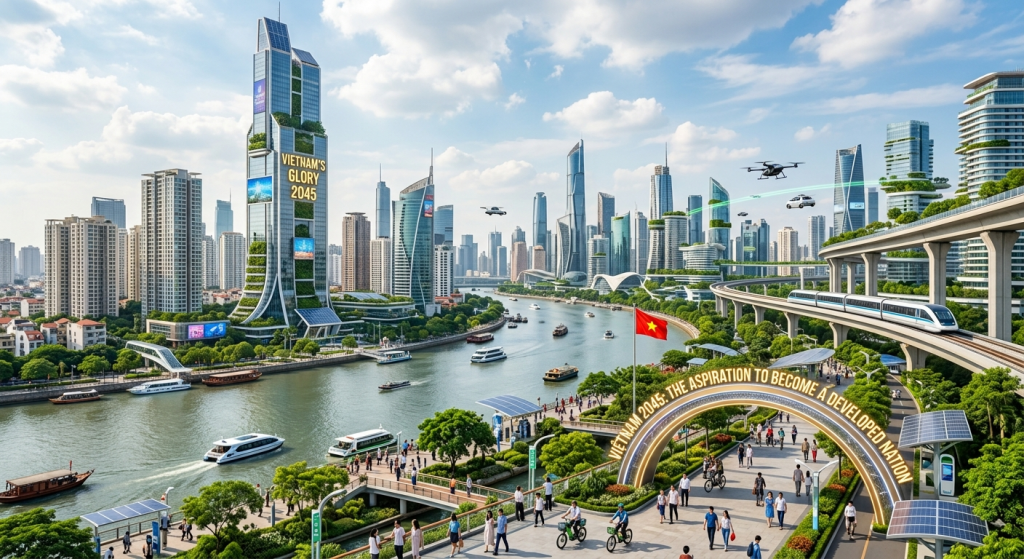
From an economy facing severe difficulties, Vietnam gradually opened its doors, embraced reform and integrated more deeply into the regional and global economy. Vietnamese products are now present in markets around the world. Millions of Vietnamese study, work and live overseas. Cities are becoming more modern, while digital technologies are transforming the way people learn, work and do business.
Yet past achievements cannot automatically guarantee future success.
The world is entering a new era of competition in which science and technology, artificial intelligence, energy, data, semiconductors, biotechnology and high-quality human resources are increasingly becoming determinants of national strength.
Vietnam’s 2045 ambition therefore requires a profound transformation: from growth driven largely by resources and labor toward growth increasingly driven by productivity, knowledge, technology and innovation.
People at the Heart of Vietnam 2045
No developed nation is built simply through skyscrapers, modern highways or higher GDP figures.
The most important foundation remains people.
Vietnam has a major advantage: a large population, a dynamic workforce and a strong ability to adapt to new technologies. But demographic strength will become less meaningful if it is not transformed into higher-quality human capital.
By 2045, Vietnam will need citizens capable of lifelong learning, using technology, thinking independently, creating new ideas and working effectively in an international environment.
Education, therefore, should go beyond transferring knowledge. It should help people ask better questions, create, collaborate and generate new value.
A developed nation needs not only outstanding engineers and scientists, but also skilled workers, responsible entrepreneurs, dedicated teachers, technology-enabled farmers and citizens committed to building their communities.
Technology and Artificial Intelligence: Vietnam’s Opportunity
If the 20th century was profoundly shaped by industrialization and electrification, the 21st century is being shaped by data, connectivity and artificial intelligence.
AI has the potential to transform production, research, healthcare, education and public administration.
For Vietnam, this is both a challenge and an opportunity.
Vietnam does not necessarily have to remain behind developed economies in every field. With a dynamic workforce, rapid technology adoption and an increasingly sophisticated technology ecosystem, Vietnam has an opportunity to leapfrog into emerging technological industries.
Artificial intelligence, semiconductors, robotics, biotechnology and clean energy could become important foundations of new, high-value industries.
But technology becomes national strength only when it improves everyday life.
A hospital using AI to support doctors. A school using technology to personalize learning. A farmer using weather data and sensors to improve production. A small business using AI to reach global customers.
This is what a technology-driven Vietnam could look like in 2045.
Building a Globally Competitive Economy
The ambition to become a developed nation cannot be separated from economic competitiveness.
Vietnam needs to continue strengthening domestic enterprises while selectively attracting international investment. The goal should not simply be to become a manufacturing base with competitive costs, but gradually to become a place where companies research, design, innovate and own technology.
A Vietnamese product in the future should mean more than a product manufactured in Vietnam.
It should carry Vietnamese knowledge, Vietnamese technology and Vietnamese brands capable of competing in global markets.
From electronics and software to supporting industries, logistics, high-tech agriculture, tourism and cultural industries, Vietnam still has significant opportunities to create high-value sectors.
Development Must Be Sustainable
A developed Vietnam in 2045 cannot sacrifice the environment for economic growth.
Climate change, rising sea levels, air pollution, resource depletion and rapid urbanization are creating increasingly complex challenges.
Vietnam needs to move toward a greener development model that uses resources more efficiently and reduces dependence on carbon-intensive energy.
Renewable energy, green transportation, smart cities, circular economy models and environmental technologies will become increasingly important.
The ultimate goal is not simply higher GDP, but a better quality of life.
A developed country should be a place where people can live in a safe environment, access quality healthcare and education, find meaningful employment, enjoy cultural life and have confidence in the future.
Vietnam’s Place in a Changing World
By 2045, Vietnam will not be judged solely by the size of its economy.
National influence will also be shaped by its ability to contribute to common global challenges.
Vietnam has the potential to become a country with greater influence in regional and global affairs; a major economic connector in Southeast Asia; and a destination for technology, tourism, education and culture.
The overseas Vietnamese community can also become an important source of national strength.
Millions of Vietnamese living and working around the world can serve as bridges connecting Vietnam with global knowledge, capital, technology and culture.
An outward-looking Vietnam does not mean losing its identity.
On the contrary, the deeper Vietnam integrates with the world, the more important it becomes to understand who we are.
Preserving Identity in a Changing World
A developed nation is not one that simply copies successful models from elsewhere.
Vietnam has thousands of years of history, a diverse cultural heritage, the Vietnamese language, traditional arts, cuisine, craft villages and social values shaped across generations.
In the digital era, Vietnamese culture has an unprecedented opportunity to reach global audiences.
A film, song, game, design product, dish or historical story from Vietnam can become part of global culture.
Developing the cultural and creative industries is therefore not only an economic opportunity. It is also a way for Vietnam to tell its own story to the world.
Vietnam 2045 Will Be Determined Today
2045 may seem far away.
But no nation can build its future in a single day.
The education decisions made today will shape the workforce of 2045. Investments in science today will create tomorrow’s technologies. The cities, infrastructure and energy systems built today will influence the quality of life of future generations.
Therefore, the most important question is not simply:
“What will Vietnam look like in 2045?”
It is:
“What must we do today to create the Vietnam of 2045?”
The answer lies in institutional reform, education, science and technology, entrepreneurship, human capital and the shared responsibility of society.
A New Century of Vietnamese Aspiration
1945 opened a new chapter in Vietnam’s modern history.
2045 could become another defining milestone: a moment when Vietnam looks back on a century of nation-building and affirms its place in the international community.
The road ahead will not be easy.
Economic uncertainty, technological competition, climate change and challenges that cannot yet be fully predicted will continue to test the country.
But Vietnam’s history also demonstrates something important: a nation can overcome enormous challenges when it possesses aspiration, determination and the ability to adapt.
Vietnam 2045 should therefore be more than a distant number.
It should be a commitment to future generations:
a stronger, more innovative, greener, more civilized and more confident Vietnam engaging with the world.
And that journey does not begin in 2045.
It begins today.
Leave a Reply