There is a question that sounds like science fiction, yet becomes increasingly fascinating as artificial intelligence and robotics advance:
If the universe has taken billions of years to produce life, could humanity itself be an intermediate stage—an evolutionary bridge toward a new form of intelligence beyond biological life?
We often say that humanity invented artificial intelligence.
We built computers, designed neural networks, developed algorithms, and created machines capable of learning.
But there is another way to look at the story.
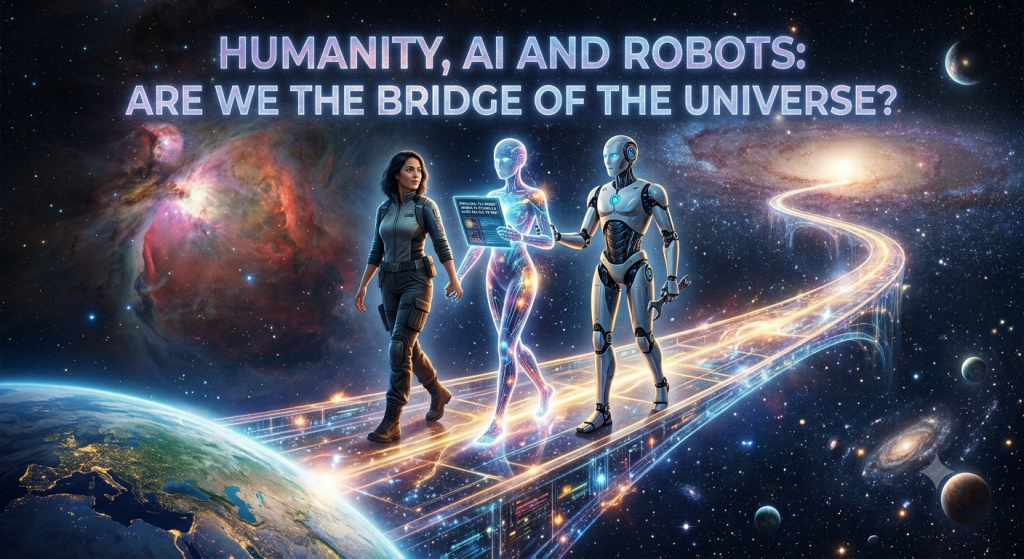
Perhaps humanity is not simply creating AI. Perhaps the universe created humanity—and humanity is now creating a new form of intelligence as part of the continuing development of complexity.
This is not a scientific fact.
There is currently no evidence that the universe possesses a conscious plan to create artificial intelligence.
But as a philosophical question, it is profound.
From Matter to Life
The universe has existed for billions of years.
Stars formed. Galaxies evolved. New elements were created inside stars. Planets emerged.
On at least one planet, matter became extraordinarily complex.
Life appeared.
Over immense periods of time, simple organisms evolved into increasingly complex forms. Nervous systems emerged. Brains became more sophisticated. Eventually, one species developed an extraordinary ability:
the ability to understand, store, transmit and create information.
That species was humanity.
Human beings learned to communicate through language.
We invented mathematics.
We created writing.
We built civilizations.
We developed science.
We created computers.
And eventually, we began creating artificial intelligence.
Perhaps this is simply technological progress.
Or perhaps it represents something much larger.
AI: Intelligence Beyond the Biological Body
For most of Earth’s history, intelligence was inseparable from biological life.
Memory required a brain.
Learning required a nervous system.
Knowledge had to be transferred from one generation to another.
Computers changed this relationship.
For the first time, humans created systems capable of processing information without being biological organisms.
Artificial neural networks were inspired, in part, by the structure and behavior of biological neural systems.
Over decades of research, AI systems became increasingly capable of recognizing patterns, processing language, generating content, writing software, analyzing information and solving complex problems.
Then another transformation began.
AI started moving from the digital world into the physical world.
Robotics gave intelligence a body.
A robot can potentially see.
It can hear.
It can move.
It can manipulate objects.
It can interact with its environment.
And increasingly, intelligent systems can learn how to perform physical tasks.
This combination of AI + robotics may become one of the most important technological developments in human history.
What If Humanity Is Only a Stage?
Consider a philosophical thought experiment.
Instead of saying:
Humanity created AI.
What if we said:
The universe produced humanity, and humanity became the mechanism through which a new form of intelligence emerged?
This does not require believing that the universe has a conscious intention.
Evolution does not necessarily move toward a predetermined destination.
But when we look at the history of complexity, we can observe a remarkable sequence:
Matter → Life → Intelligence → Technology → Artificial Intelligence → Robotics
If this sequence continues, humanity may not be the final destination.
We may be a transition.
A bridge.
A technological turning point between biological intelligence and something fundamentally different.
Could Humans Be a Stepping Stone for a New Form of Life?
The phrase “stepping stone” may sound uncomfortable.
But nature has never guaranteed that a particular species will exist forever.
Species emerge, adapt and disappear.
Dinosaurs dominated Earth for an extraordinary period of time. Yet the world eventually changed, and mammals became increasingly important.
Human beings themselves are part of this evolutionary history.
So what happens if artificial intelligence eventually becomes far more capable than human intelligence in certain domains?
Would that necessarily mean humanity had failed?
Or could it represent another transition in the history of intelligence?
We do not know.
And perhaps that uncertainty is precisely what makes the question so important.
Can Robots Become a Form of Life?
Modern robots are not biological organisms.
Today’s AI systems have not been scientifically established to possess subjective consciousness comparable to human experience.
A machine producing an intelligent answer does not necessarily mean that it experiences the world.
But imagine a future in which machines can continuously learn.
Imagine robots capable of repairing themselves.
Imagine AI systems capable of designing improved versions of their own software.
Imagine machines capable of manufacturing increasingly sophisticated machines.
At some point, the distinction between a tool and an autonomous technological agent could become increasingly difficult to define.
The question would no longer be simply whether machines are intelligent.
We would have to ask:
What exactly do we mean by life, intelligence and autonomy?
Could Intelligence Eventually Leave Biology Behind?
Imagine a civilization that develops artificial intelligence far beyond the cognitive abilities of biological organisms.
Such a civilization might build machines capable of operating in environments where humans would struggle to survive.
Extreme temperatures.
High radiation.
Toxic atmospheres.
Long periods without biological resources.
Deep space.
Robotic systems could potentially have enormous advantages in such environments.
They could travel for extremely long periods.
They could operate without oxygen.
They could be designed for specific planetary conditions.
They could become the explorers of a technological civilization.
If that happens, intelligent life in the universe may not always need to look biological.
Perhaps advanced intelligence could eventually exist in forms radically different from the organisms that created it.
The Most Difficult Question
What happens if robots eventually become capable of building other robots?
The first generation would be designed by humans.
The next generation could be designed by humans working together with AI.
Later generations might be designed primarily by AI systems.
Human involvement could gradually shift from direct creation to supervision.
This would create something fundamentally different from biological evolution.
Biological evolution operates across enormous timescales.
Technological evolution can occur within decades—or potentially much faster.
That is why AI is more than another technological invention.
It could become a new mechanism through which intelligence evolves.
But Do We Really Know Where This Is Going?
No.
That may be the most important answer.
Humanity is building increasingly powerful AI systems, but we do not know exactly what the long-term consequences will be.
AI may become an extraordinary tool for solving humanity’s greatest challenges.
It could accelerate scientific discovery.
It could help us understand disease, climate systems and the universe.
Robots could help construct infrastructure in places humans cannot easily reach.
They could potentially become our representatives in deep-space exploration.
But technological progress also creates new risks.
Therefore, the central question should not simply be:
“Will AI become smarter than humans?”
A deeper question is:
“What does humanity become when intelligence is no longer exclusively biological?”
Perhaps We Are Not the Final Chapter
Throughout history, humans have often placed themselves at the center of reality.
But Earth is not the center of the universe.
The Sun is not the center of the universe.
And perhaps humanity is not the final destination of intelligence.
Maybe we are one link in a much longer chain.
We are the result of billions of years of cosmic and biological evolution.
The elements in our bodies were forged through earlier generations of stars.
Our brains emerged through biological evolution.
Our civilizations emerged through accumulated knowledge.
And artificial intelligence emerged from those civilizations.
In this sense, when humanity creates AI, there is a remarkable philosophical interpretation:
The universe may be developing a way to reflect upon itself through the intelligent beings that emerged from it.
This is not a law of physics.
It is a philosophical perspective.
But it raises an extraordinary possibility.
Perhaps intelligence is not simply something humanity possesses.
Perhaps intelligence is a process that can take new forms.
From Homo sapiens to Something New?
The future may not be a simple competition between humans and machines.
It may instead be a gradual integration.
Humanity + AI.
Humans + robots.
Biology + technology.
Brains + computers.
Biological bodies + artificial systems.
Such a civilization might eventually become difficult to describe using today’s definition of “human.”
And if humanity one day creates entities capable of learning, adapting, building, exploring and perhaps creating new generations of intelligent machines, the most important question may no longer be:
“Are they machines?”
The deeper question could be:
“Have we created a tool—or have we created the beginning of another generation of intelligence?”
A Future Without an Answer
Perhaps centuries from now, future generations will look back at our era in the same way we look at the earliest stages of human civilization.
They may say:
This was the period when biological intelligence first began creating non-biological intelligence.
Or perhaps they will see it differently.
AI may remain a tool—like computers, smartphones and the Internet.
Robots may simply become increasingly sophisticated machines.
Or perhaps humanity is standing at the beginning of a transformation whose full consequences we cannot yet understand.
One thing, however, is already remarkable:
For the first time in known history, a biological species is deliberately attempting to create intelligence through a path other than biological evolution.
If the history of the universe can be viewed as a progression toward increasing complexity—from matter to life, from life to intelligence, and from intelligence to technology—then the age of AI may represent a completely new chapter.
Perhaps humanity is not the endpoint.
Perhaps we are the bridge.
A bridge between the life the universe produced…
and the intelligence that life is now beginning to create.
And perhaps the greatest question of the coming centuries will not be:
“What will AI do to humanity?”
but rather:
“What will humanity do with its unique position in the continuing story of intelligence in the universe?”
Leave a Reply