By VietnamHub English | Global Perspective
The world is entering a period of profound transformation.
Technology is advancing at extraordinary speed. Artificial intelligence is changing the way people work, communicate and make decisions. Climate change is reshaping economies and communities. Wars and geopolitical rivalries are challenging the international order. At the same time, billions of people are asking a fundamental question: What kind of world are we building for the next generation?
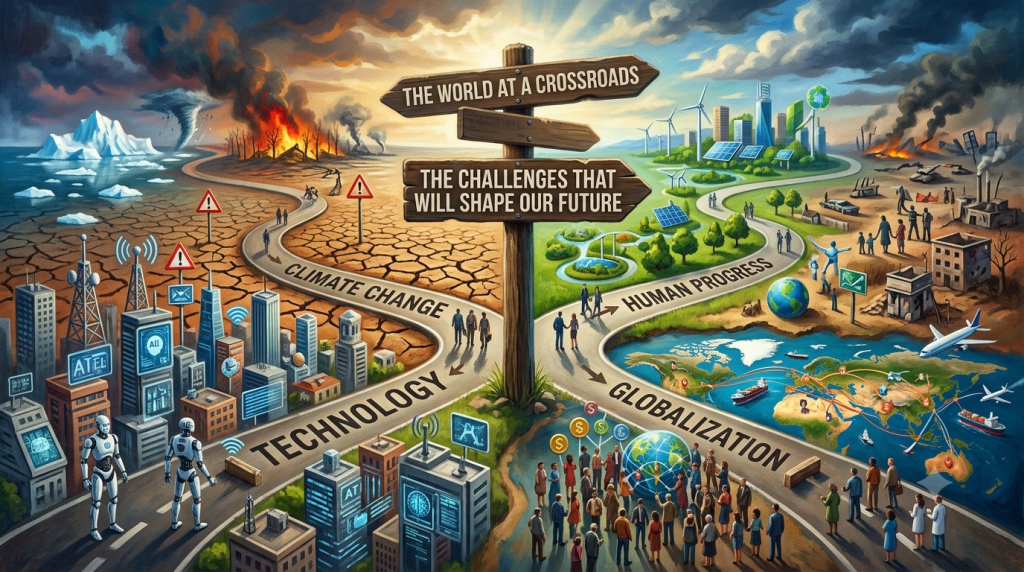
These challenges are deeply connected. A conflict in one region can affect energy prices and food security elsewhere. A technological breakthrough can create enormous economic opportunities while also disrupting jobs and increasing security risks. Climate disasters can accelerate migration, deepen inequality and place additional pressure on governments.
The future of humanity will therefore depend not only on individual countries, but increasingly on the ability of the international community to cooperate.
1. A More Uncertain Geopolitical World
Geopolitical tensions have become one of the defining concerns of the 2020s.
Competition among major powers is increasingly affecting trade, technology, energy, investment and supply chains. The World Economic Forum’s 2026 Global Risks Report identifies geoeconomic confrontation as the leading short-term global risk, followed by state-based armed conflict. (World Economic Forum)
The world is becoming more multipolar, but multipolarity does not automatically mean greater cooperation.
Countries are seeking greater strategic autonomy. Governments are reconsidering their dependence on foreign technology, energy and critical materials. Trade restrictions, tariffs, sanctions and export controls are increasingly being used not only for economic purposes but also as instruments of national security.
The central challenge is therefore clear:
Can countries compete without allowing competition to become confrontation?
The answer will have enormous consequences for global stability.
2. Artificial Intelligence: Opportunity and Risk
Few technologies have attracted as much attention as artificial intelligence.
AI is already transforming education, healthcare, scientific research, manufacturing, finance, media and creative industries. The United Nations notes that AI has the potential to contribute significantly to sustainable development and could support progress across many of the Sustainable Development Goals. (Liên Hợp Quốc)
But the same technology also creates difficult questions.
Who is responsible when an AI system makes a serious mistake?
How should societies respond when automation changes millions of jobs?
How can governments prevent AI from being used for cyberattacks, manipulation, fraud or military purposes?
And perhaps the most important question:
Can humanity build sufficiently strong institutions to govern technologies that are evolving faster than traditional regulation?
The UN’s 2026 scientific horizon report identifies governance gaps—including regulatory delays, unequal access, opaque systems and declining trust—as major sources of technological risk. (Liên Hợp Quốc)
AI should not simply be viewed as a competition between countries or companies.
It is becoming a question about the future relationship between humans, machines and society.
3. Climate Change Is No Longer a Distant Threat
Climate change has moved from a future scenario to a present reality.
Extreme heat, floods, droughts, storms, wildfires and rising sea levels are placing increasing pressure on communities around the world. The consequences extend beyond the environment. They affect agriculture, food prices, infrastructure, migration, public health and economic stability.
Recent international discussions have also highlighted the growing problem of drought and land degradation. Up to 40% of the world’s land is estimated to be degraded, creating serious challenges for agriculture, water security and rural communities. (AP News)
The greatest challenge is that climate risks are not distributed equally.
Countries and communities with fewer financial resources often have less capacity to protect themselves, rebuild infrastructure and adapt to changing conditions.
This creates an important global question:
Who should pay for climate adaptation and resilience?
The answer will test the principle of international solidarity.
4. The Global Economy Under Pressure
The global economy is also undergoing a major transition.
High levels of public and private debt, inflationary pressures, trade tensions, energy risks and uncertain investment conditions are creating difficult choices for governments and central banks.
The IMF has warned that high debt, persistent inflation and trade tensions remain downside risks for the global economy, even as investment in AI and technology provides a potential source of productivity and growth. (Reuters)
The world therefore faces an interesting contradiction.
Technology is creating new wealth and productivity.
Yet economic opportunities are not necessarily distributed equally.
If technological gains are concentrated among a small number of countries, corporations or individuals, inequality could increase rather than decrease.
The challenge for policymakers is not simply to create economic growth.
It is to create inclusive growth.
5. The Future of Work
For generations, technological change has transformed employment.
But AI may accelerate this process dramatically.
Some jobs will disappear or shrink. Others will change. Entirely new professions may emerge.
The most valuable skills of the future may increasingly include creativity, critical thinking, communication, adaptability and the ability to work alongside intelligent machines.
Education systems therefore face a major challenge.
A diploma may no longer be enough for an entire career.
People may need to learn continuously throughout their working lives.
The future of work will depend not only on how powerful AI becomes, but also on whether societies can help people adapt to it.
6. Information, Trust and the Battle Against Misinformation
Another issue receiving increasing global attention is the information environment.
Social media and AI-generated content have made it easier than ever to create and distribute information.
This creates extraordinary opportunities for communication—but also new risks.
Deepfakes, manipulated videos, fabricated images and misleading narratives can influence public opinion, damage reputations and create confusion during elections or international crises.
The problem is larger than misinformation itself.
It is the gradual erosion of trust.
When people can no longer distinguish between authentic and manipulated information, society becomes more vulnerable to polarization.
The future may therefore require not only better technology, but also stronger journalism, media literacy, transparency and public institutions.
7. War, Peace and Human Security
Conflicts remain among the most devastating challenges facing humanity.
Modern warfare is changing rapidly through drones, cyber capabilities, artificial intelligence and increasingly sophisticated weapons systems.
The debate over autonomous weapons has become especially urgent. The United Nations and the International Committee of the Red Cross have called for international rules governing autonomous weapon systems, warning about the consequences of allowing machines to make life-and-death decisions without meaningful human control. (Reuters)
Technology may make warfare more precise.
But it can also make conflict faster, cheaper and potentially harder to control.
Humanity must therefore establish clear boundaries before technology crosses them.
8. Inequality and the Question of Opportunity
Economic inequality remains one of the world’s most interconnected challenges.
The World Economic Forum’s 2026 report identifies inequality as the most interconnected global risk over the longer term. (World Economic Forum)
Inequality is not only about income.
It includes access to education, healthcare, technology, finance, information and opportunities.
A child born in one part of the world may have access to advanced digital education and healthcare. Another child, born elsewhere, may lack reliable electricity or internet access.
The technological revolution could narrow this gap—or widen it.
The difference will depend on policy, investment and international cooperation.
9. Can the World Still Cooperate?
Perhaps the greatest question behind all these challenges is whether countries can still work together.
The United Nations describes many global problems—from climate change and conflict to development and human rights—as challenges that cannot be solved by any one country acting alone. (Liên Hợp Quốc)
Yet international cooperation is under pressure.
Rivalries between major powers are increasing. Trust between governments is weakening. Protectionism is rising. International institutions are facing questions about their effectiveness.
At the same time, humanity has never been more interconnected.
A virus can cross borders within hours.
A financial crisis can spread across continents.
A cyberattack can originate thousands of kilometres away.
Climate change ignores national boundaries.
And artificial intelligence does not recognize borders.
The logic of the modern world therefore creates a paradox:
Countries are becoming more competitive at precisely the moment when cooperation is becoming more necessary.
10. The Future Is Not Yet Written
The challenges facing humanity may appear overwhelming.
But history has repeatedly demonstrated that human beings are capable of adapting, innovating and solving problems that once seemed impossible.
The development of vaccines, the expansion of global communications, the reduction of extreme poverty in many regions, advances in renewable energy and the rapid growth of digital technology all demonstrate the extraordinary capacity of human societies to change.
The question is not whether humanity has the technology to build a better future.
Increasingly, it is whether humanity has the wisdom, institutions and cooperation to use that technology responsibly.
The coming decade will be decisive.
Artificial intelligence will reshape economies.
Climate change will test societies.
Geopolitical competition will challenge international institutions.
Demographic changes will transform labour markets.
And billions of people will demand greater security, dignity and opportunity.
A Shared Future
The world does not need to become a place without competition.
Competition can encourage innovation.
Different cultures and political systems can coexist.
Economic development can create prosperity.
Technology can expand human possibilities.
But competition must be balanced by responsibility.
Power must be balanced by accountability.
Innovation must be balanced by ethics.
Economic growth must be balanced by inclusion.
And national interests must be balanced by an understanding that humanity ultimately shares one planet.
The greatest challenge of the 21st century may therefore not be artificial intelligence, climate change, war or economic instability alone.
It may be our ability to manage all of them at the same time.
The future will not be decided by technology alone.
It will be decided by the choices humanity makes.
And those choices begin today.
VietnamHub Global Perspective
Vietnam is part of this changing world.
As a rapidly developing country with a young population, a growing digital economy and an increasingly important position in Asia, Vietnam has an opportunity to contribute to global conversations—not only as an observer, but as an active participant.
From technology and artificial intelligence to culture, education, sustainable development and international cooperation, Vietnam’s future is increasingly connected to the future of the world.
VietnamHub English aims to contribute to that conversation by looking at Vietnam from a global perspective—and looking at the world through a Vietnamese lens.
Because understanding the world is one of the first steps toward shaping the future.
Leave a Reply