How Technology Is Transforming the Way We Live, Work, Think and Connect
We are living through one of the most extraordinary periods in human history. Technology is no longer something that exists outside our daily lives. It has become deeply integrated into the way we communicate, work, learn, travel, shop, entertain ourselves and even understand the world around us.
From smartphones and artificial intelligence to biotechnology, robotics, cloud computing and smart cities, technological development is accelerating at a remarkable speed. The question is no longer whether technology will change human life. It already has. The bigger question is: what kind of human life are we creating in this technological age?
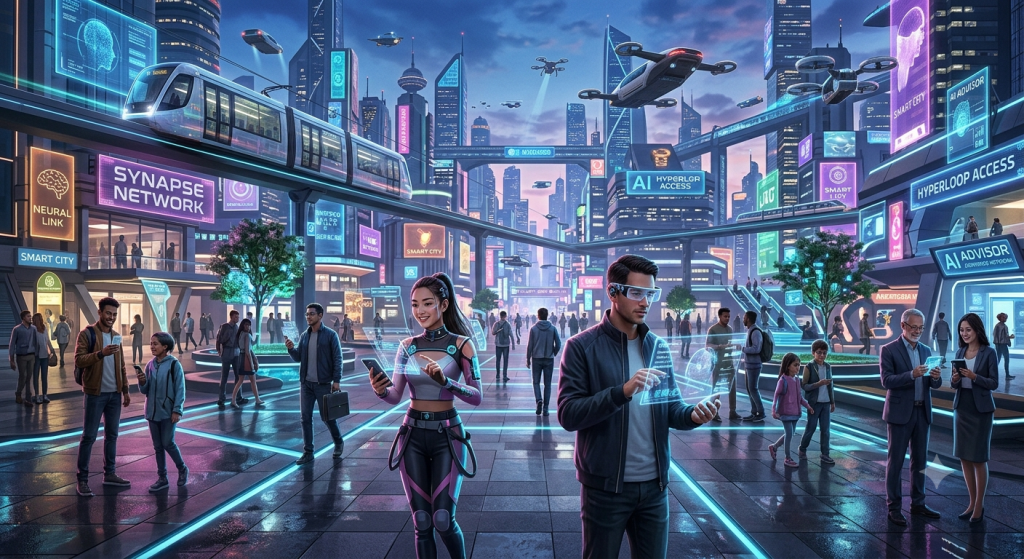
A World That Never Sleeps
For most of human history, distance was a major barrier. A message could take days, weeks or even months to reach another person. Today, a smartphone can connect people across continents within seconds.
Social networks, video calls and instant messaging have created a world in which geographical distance matters less than ever before. Families separated by thousands of kilometers can see each other every day. Businesses can operate across borders. A young person in a small town can communicate with people from almost any country.
But constant connectivity also creates a new challenge: the world rarely feels quiet anymore.
Notifications, emails, messages, videos and news continuously compete for our attention. Many people begin and end their day by looking at a screen. Technology gives us unprecedented access to information, but it also makes it increasingly difficult to disconnect.
Artificial Intelligence and the New Human Workplace
Perhaps no technology is changing expectations about the future as rapidly as artificial intelligence.
AI can now write, translate, analyze data, generate images, assist programmers, support scientific research and automate many repetitive tasks. In factories, robots can perform precision operations. In offices, software can process enormous amounts of information in seconds.
This transformation creates both opportunity and uncertainty.
Some jobs will disappear or become significantly different. At the same time, new professions and industries will emerge. The ability to work alongside intelligent machines may become one of the most important skills of the coming decades.
The future workplace may not be defined by humans competing against machines. Instead, it may be defined by humans working with machines.
Creativity, critical thinking, emotional intelligence, leadership and the ability to make responsible decisions could become increasingly valuable precisely because these qualities remain deeply connected to human experience.
Education Is Becoming Borderless
Technology is also changing how people learn.
A student no longer needs to be physically present in a traditional classroom to access knowledge. Online courses, digital libraries, educational platforms and AI-powered learning tools have made education available to millions of people.
A person living in a remote area can study subjects taught by universities and experts on the other side of the world. Language barriers are gradually being reduced by real-time translation technologies.
However, access to information does not automatically create wisdom.
The ability to distinguish reliable information from misinformation is becoming just as important as the ability to find information itself. In an age when anyone can publish content and artificial intelligence can generate convincing text, images and videos, digital literacy has become an essential part of modern citizenship.
The Smartphone: A Second Brain?
For many people, the smartphone has become an extension of the human mind.
It stores contacts, photographs, documents, maps, financial information, entertainment and memories. It can answer questions, translate languages, navigate cities and help people communicate with almost anyone.
But dependence on technology raises an important question: Are we becoming smarter, or are we simply becoming better at accessing machines that remember and calculate for us?
The answer may be both.
Technology can expand human capabilities, but excessive dependence can weaken certain skills. People may remember fewer phone numbers, rely more heavily on navigation systems and become uncomfortable when they are disconnected from the internet.
The challenge is not to reject technology, but to ensure that technology remains a tool rather than becoming the master of our attention.
Human Relationships in a Digital World
Technology has brought people closer together in some ways and farther apart in others.
A person can have hundreds or thousands of online connections while still experiencing loneliness. A family may sit together in the same room while each person looks at a different screen.
Digital communication is fast and convenient, but human relationships require more than messages and emojis. Friendship, love, trust and empathy are built through shared experiences, physical presence and genuine attention.
The technological age therefore presents a paradox: we have never been more connected, yet meaningful connection has never been more important.
Technology and Human Health
Modern technology is also changing healthcare.
Artificial intelligence can assist doctors in analyzing medical images. Wearable devices can monitor heart rate, sleep and physical activity. Telemedicine allows patients to communicate with healthcare professionals without always needing to travel long distances.
Biotechnology and advanced medical research may eventually allow humanity to treat diseases that were once considered untreatable.
Yet technology also creates new health concerns. Long periods of screen use, sedentary lifestyles, digital addiction and constant exposure to online information can affect physical and psychological well-being.
The future of health will therefore involve not only better medical technology, but also learning how to live responsibly with technology.
Smart Cities and a Changing Planet
Technology is transforming entire cities.
Smart transportation systems, electric vehicles, renewable energy, intelligent buildings and automated public services are changing how urban environments function.
Data can help cities manage traffic, reduce energy consumption and improve public services. Artificial intelligence can analyze enormous quantities of information to help governments understand urban problems more quickly.
At the same time, technological progress consumes enormous amounts of energy and resources.
Data centers, electronic devices, batteries and industrial systems all have environmental costs. The future challenge is therefore not simply to develop more powerful technology, but to develop technology that is more sustainable.
The Danger of Losing the Human Element
Perhaps the greatest challenge of the technological era is not technological itself.
It is human.
When technology becomes increasingly powerful, society must decide how that power should be used.
Should AI make important decisions about people’s lives? How should personal data be protected? Who is responsible when an automated system makes a serious mistake? How can societies prevent technology from increasing inequality?
These questions cannot be answered by engineers alone. They require philosophers, scientists, governments, educators, businesses and ordinary citizens to participate in a global conversation about the future.
The Future Belongs to Humans Who Can Adapt
The technological revolution is not going to stop.
Artificial intelligence will become more capable. Robots will become more common. Biotechnology will advance. Virtual and augmented reality may change how people experience digital environments. Autonomous systems may transform transportation and industry.
But technology itself does not determine the future.
Human choices do.
Technology can be used to educate or manipulate, to connect or isolate, to heal or harm, to protect the planet or exploit it.
The defining characteristic of the next era may therefore not be how intelligent our machines become, but how wisely humanity chooses to use them.
We are entering a world in which the boundary between the physical and digital worlds is becoming increasingly blurred. Our homes are becoming smarter, our workplaces more automated, our cities more connected and our machines more intelligent.
Yet beneath all these changes, one thing remains unchanged: people still seek meaning, love, friendship, security, dignity and hope.
Technology can help humanity reach further than ever before.
But it cannot decide where we should go.
That decision remains ours.
Leave a Reply