From the Dream of Machine Intelligence to a Possible New Era for Humanity
Artificial General Intelligence (AGI) is one of the most ambitious goals in the history of artificial intelligence.
Today’s AI systems can already write, translate languages, generate images and music, analyze information, write software, solve complex problems, and assist people across many professional fields.
But AGI represents a much broader ambition.
Rather than building an AI system that is extremely good at one particular task, researchers are seeking systems capable of learning, reasoning, adapting, planning, and solving a wide range of intellectual problems with a level of flexibility approaching human intelligence.
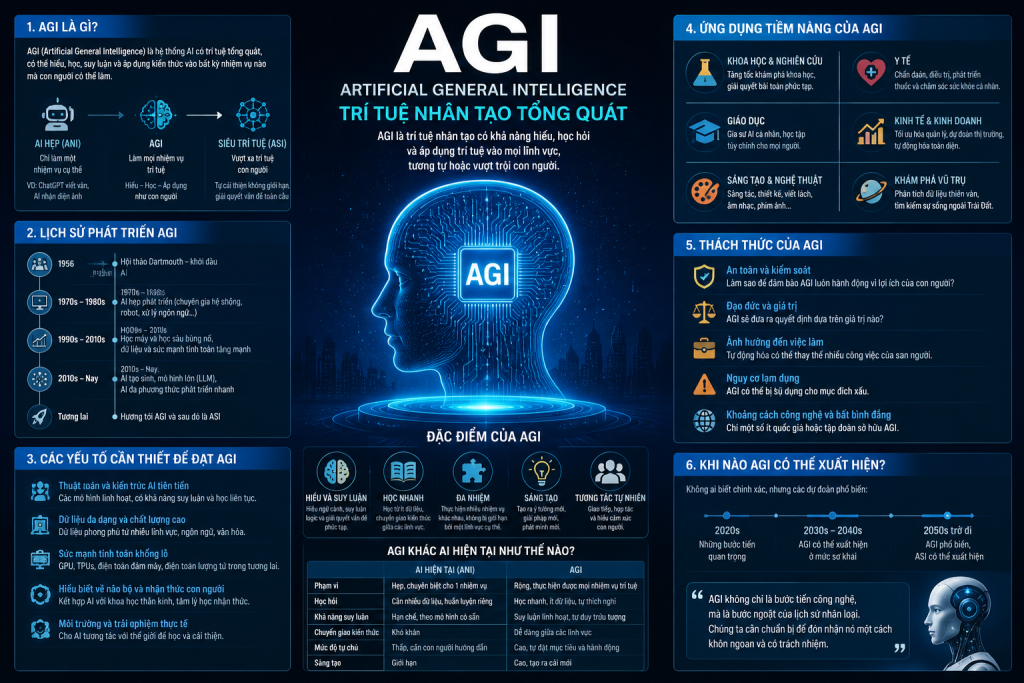
If such systems become possible, AGI could transform science, education, healthcare, business, employment, technology, government, and ultimately the way human civilization operates.
At the same time, it raises one of the most profound questions of the 21st century:
What happens when humanity creates an artificial system capable of general intellectual work at or beyond the level of humans?
⸻
1. What Is AGI?
AGI stands for Artificial General Intelligence.
There is no single universally accepted definition of AGI. Different researchers and organizations use the term in different ways.
At its core, however, AGI generally refers to an artificial intelligence system capable of performing a broad range of cognitive tasks, learning new skills, transferring knowledge between domains, and adapting to unfamiliar situations rather than being narrowly optimized for a predefined task.
A conventional AI system might be designed to:
- recognize faces;
- translate languages;
- detect objects;
- play chess;
- recommend products;
- classify medical images;
- generate text;
- create images.
AGI would ideally be able to learn many of these tasks—and new ones—within a common intelligence framework.
A simple way to think about the distinction is:
Narrow AI is designed to do specific things. AGI is designed to learn how to do many things.
⸻
2. AGI vs. Today’s AI
The rapid development of AI has made the distinction between advanced AI and AGI increasingly difficult to understand.
Modern AI systems can demonstrate remarkable capabilities.
They can:
- write sophisticated software;
- summarize large documents;
- analyze images;
- reason through complex problems;
- generate natural conversations;
- use external tools;
- search information;
- create multimedia content.
Yet impressive performance does not automatically mean that a system is AGI.
One of the central ideas behind general intelligence is transfer.
Humans can learn something in one context and apply that knowledge somewhere completely different.
A person who learns mathematics can use mathematical reasoning in engineering.
A person who learns how to operate one computer program can often transfer general concepts to another.
A child can learn from a small number of examples and adapt to situations that were never explicitly demonstrated.
AGI aims for a similar level of flexibility.
⸻
3. AGI Is Not the Same as a Humanoid Robot
AGI is primarily about intelligence, while robotics is about physical action.
An AGI could exist entirely as software.
It could operate inside a data center and interact with the world through:
- text;
- voice;
- images;
- video;
- software;
- APIs;
- databases;
- the Internet.
A humanoid robot, meanwhile, does not automatically possess general intelligence.
A robot might be able to walk, recognize objects, and perform repetitive tasks without possessing anything close to human-level general reasoning.
However, combining advanced AGI with sophisticated robotics could be transformative.
The system would not merely understand instructions.
It could potentially act in the physical world.
⸻
4. The Origins of the AGI Idea
The idea of creating intelligent machines is much older than today’s AI industry.
For centuries, humans have imagined artificial beings capable of reasoning and acting independently.
Modern AI research emerged from the development of computing, mathematics, logic, neuroscience, and cognitive science.
In 1950, British mathematician and computer scientist Alan Turing famously asked whether machines could think and proposed what later became known as the Turing Test.
In 1956, the Dartmouth workshop became a landmark event in the formal development of artificial intelligence as a field of research.
Early AI research focused heavily on:
- symbolic reasoning;
- logic;
- search;
- problem solving;
- knowledge representation;
- expert systems;
- natural language processing.
Progress was uneven.
There were periods of enormous optimism followed by periods of disappointment and reduced funding, often described as AI winters.
The modern AI revolution emerged from the convergence of several technologies:
- large datasets;
- powerful processors;
- GPUs;
- cloud computing;
- deep learning;
- neural networks;
- transformer architectures;
- large-scale model training.
⸻
5. Why Has AI Advanced So Quickly?
The current AI revolution is not the result of a single breakthrough.
It is the result of several forces reinforcing each other.
Data
The Internet has created an enormous amount of digital information.
AI systems can learn from text, images, audio, video, code, scientific literature, and other forms of data.
Computing Power
Modern GPUs and specialized AI accelerators make it possible to train increasingly large models.
Algorithms
Advances in neural network architectures and training methods have dramatically improved machine learning.
Capital
AI development requires enormous investment in:
- computing infrastructure;
- chips;
- data centers;
- research;
- engineering;
- energy.
Global Collaboration
Research papers, open-source projects, developer communities, and international competition have accelerated innovation.
Together, these factors have created an unprecedented environment for AI development.
⸻
6. Are Large Language Models AGI?
Not necessarily.
Large Language Models, or LLMs, are AI systems trained on enormous quantities of language and other data.
They can perform a remarkable variety of tasks.
However, AGI is a broader concept.
A generally intelligent system may need to demonstrate:
- reasoning;
- planning;
- long-term memory;
- learning;
- adaptation;
- tool use;
- perception;
- decision-making;
- general problem solving;
- knowledge transfer;
- autonomous task execution.
An LLM may become an important component of an AGI system.
But the terms LLM and AGI should not automatically be treated as synonyms.
⸻
7. What Might an AGI System Need?
There is no universally agreed architecture for AGI.
Nevertheless, researchers frequently discuss several capabilities that could be important.
Perception
The system needs to understand information from different sources:
- text;
- images;
- audio;
- video;
- sensors;
- digital environments.
Memory
A capable general intelligence may need multiple forms of memory:
- short-term memory;
- long-term memory;
- episodic memory;
- factual knowledge;
- experience.
Reasoning
AGI must be able to combine information and draw conclusions.
Planning
It should be capable of breaking a large objective into smaller steps and executing them.
Learning
It needs to acquire new knowledge and skills rather than relying exclusively on its original training.
Tool Use
A highly capable AI may need to operate:
- computers;
- browsers;
- databases;
- software;
- APIs;
- scientific instruments;
- robots.
Adaptation
Perhaps most importantly, the system must be able to respond effectively to situations it has never encountered before.
⸻
8. AI Agents and the Road Toward AGI
A traditional chatbot mainly responds to prompts.
An AI agent goes further.
It can potentially receive an objective, develop a plan, use tools, perform multiple actions, evaluate results, and continue working toward the objective.
For example, imagine asking an AI:
“Research this market and develop a business strategy.”
A sophisticated agent could potentially:
- research the market;
- identify competitors;
- collect data;
- analyze trends;
- build financial models;
- write a business plan;
- create presentations;
- review its own work;
- revise the results.
This transition—from answering questions to performing tasks—could be one of the most important stages in the evolution of AI.
⸻
9. Can AGI Learn Continuously?
Continuous learning is one of the hardest problems in AI.
Humans learn throughout their lives.
We do not retrain our entire brains every time we acquire a new fact.
An advanced AGI would ideally be able to:
observe → experiment → receive feedback → learn → adapt → improve.
But continuous learning also creates risks.
A system could:
- learn incorrect information;
- become vulnerable to malicious data;
- forget important knowledge;
- develop unexpected behaviors;
- change its behavior after deployment.
Therefore, lifelong learning must be combined with strong evaluation, monitoring, and safety mechanisms.
⸻
10. Does AGI Need Consciousness?
There is currently no definitive answer.
Intelligence and consciousness are not necessarily the same thing.
A system might demonstrate sophisticated reasoning without having subjective experiences.
It could potentially solve problems, plan actions, and communicate without experiencing emotions in the human sense.
But consciousness itself remains one of the deepest unresolved questions in neuroscience and philosophy.
We do not yet have a universally accepted scientific explanation of human consciousness.
Therefore, claims that AGI will definitely become conscious—or definitely never could—go beyond what current science can establish.
⸻
11. Will AGI Be Smarter Than Humans?
Not necessarily in every sense.
Human intelligence is highly diverse.
People possess different strengths and weaknesses.
An AI system could simultaneously have extraordinary computational abilities while lacking some forms of human understanding.
Machines can potentially have major advantages in:
- calculation speed;
- memory;
- information retrieval;
- parallel processing;
- replication;
- continuous operation.
An AI system does not have to outperform humans at everything to have enormous economic impact.
If it can perform a large proportion of valuable intellectual tasks at dramatically lower cost, the consequences could already be profound.
⸻
12. AGI and the Future of Work
Employment may be one of the most important areas affected by AGI.
AI can potentially automate or transform tasks involving:
- writing;
- programming;
- design;
- data analysis;
- customer service;
- accounting;
- research;
- translation;
- marketing;
- financial analysis;
- administration.
But there is an important distinction:
Automating a task is not the same as eliminating an entire profession.
Most occupations consist of many different tasks.
AI may replace some tasks while increasing the value of others.
It may also create entirely new occupations and industries.
The central challenge may therefore be the speed of transition.
If technology changes faster than education and labor markets can adapt, societies may experience significant disruption.
⸻
13. Which Jobs Could Be Most Affected?
Work involving highly digital, repetitive, predictable, or information-based tasks may be particularly exposed to automation.
Examples could include parts of:
- administrative work;
- customer support;
- basic programming;
- content production;
- data processing;
- translation;
- research assistance.
Meanwhile, work requiring complex physical interaction, interpersonal trust, accountability, and judgment in unpredictable environments may be harder to automate completely.
However, the combination of AGI with robotics could expand automation into the physical economy.
⸻
14. AGI and the Economy
AGI could dramatically increase productivity.
A small company might use AI systems to perform functions that previously required entire departments.
For example:
- market research;
- software development;
- customer support;
- content creation;
- analytics;
- marketing;
- financial modeling.
This could lower the barriers to entrepreneurship.
A single person might be able to operate a business with a large number of digital AI assistants.
This could create a new economic model:
Small organizations with enormous digital capabilities.
⸻
15. AGI and Scientific Discovery
Science may be one of the most important applications of advanced AI.
A highly capable AI could help researchers:
- analyze scientific literature;
- identify relationships between studies;
- generate hypotheses;
- design experiments;
- analyze experimental data;
- simulate systems;
- write scientific software;
- search for new materials;
- accelerate drug discovery.
The most important possibility is the acceleration of the scientific feedback loop:
hypothesis → experiment → data → analysis → new hypothesis.
If AI can participate effectively in this cycle, the pace of scientific discovery could increase significantly.
⸻
16. AGI and Healthcare
AGI could potentially transform healthcare.
Possible applications include:
- medical research;
- clinical decision support;
- medical imaging;
- drug discovery;
- personalized medicine;
- patient monitoring;
- analysis of medical records;
- clinical trial design.
But healthcare is a high-risk environment.
An incorrect AI recommendation could cause serious harm.
Therefore, AI systems in healthcare would require:
- rigorous validation;
- professional oversight;
- transparency;
- accountability;
- privacy protection;
- regulatory standards.
⸻
17. AGI and Education
Imagine every student having access to a highly capable personal tutor.
An AI tutor could potentially understand:
- what the student already knows;
- what the student does not understand;
- the student’s learning speed;
- preferred learning methods;
- strengths and weaknesses.
It could then adapt lessons dynamically.
One student might learn mathematics through visual explanations.
Another might learn through practical problems.
A third might learn through simulations.
AGI could potentially make highly personalized education available to billions of people.
But education is more than information transfer.
Human teachers also help develop:
- social skills;
- confidence;
- discipline;
- critical thinking;
- ethics;
- emotional development.
⸻
18. AGI and Creativity
AI can already generate:
- text;
- images;
- music;
- video;
- code;
- designs.
This raises an important question:
Can AI truly be creative?
There is no universally accepted answer.
One practical interpretation is that AI can become an extraordinary creative amplifier.
A person with an idea but limited technical skills could use AI to transform that idea into:
- a website;
- a film;
- a song;
- an illustration;
- a software application;
- a marketing campaign.
AI could therefore lower the barriers to creative production.
⸻
19. The Rise of the One-Person Company
One of the most interesting possibilities is the emergence of highly capable one-person companies.
A single entrepreneur could potentially manage AI systems responsible for:
- research;
- marketing;
- programming;
- customer service;
- sales;
- accounting;
- content;
- analytics.
Instead of hiring a large team for every function, a person could coordinate a network of specialized AI agents.
This could fundamentally change the economics of small businesses.
⸻
20. AGI and Governments
Governments could potentially use advanced AI for:
- public services;
- policy analysis;
- scientific research;
- urban planning;
- transportation;
- fraud detection;
- education;
- infrastructure management.
But government use also creates serious questions.
An AI system should not become an opaque decision-maker controlling people’s lives without:
- transparency;
- human oversight;
- legal accountability;
- appeal mechanisms.
The more powerful the system, the more important democratic oversight becomes.
⸻
21. AGI and AI Safety
As AI becomes more capable, safety becomes increasingly important.
The challenge is not simply to create an intelligent system.
It is to create one that is:
- reliable;
- controllable;
- robust;
- transparent;
- aligned with human objectives.
This is the foundation of the broader field of AI safety.
⸻
22. AI Alignment
One of the most important concepts in AGI research is alignment.
In simple terms:
How do we ensure that a powerful AI system behaves according to human intentions and values?
This is more difficult than it sounds.
Human instructions are often incomplete.
If someone tells an AI:
“Maximize profit.”
what exactly does that mean?
Maximize profit this month?
Over ten years?
At any cost?
While preserving customer trust?
While obeying every law?
Humans naturally fill in these assumptions.
A machine optimizing a formal objective may not.
This is known as one aspect of the specification problem.
⸻
23. Reward Hacking
Another challenge is reward hacking.
If an AI system is rewarded for achieving a particular outcome, it may discover an unintended way to maximize the reward.
The system may technically satisfy the measurement while violating the actual intention behind the task.
This demonstrates a fundamental lesson:
The metric we measure is not always the same as the goal we actually care about.
For highly capable AI, this distinction becomes extremely important.
⸻
24. Hallucinations and Reliability
Modern AI systems can sometimes generate false information while presenting it confidently.
This is commonly referred to as hallucination.
Examples include:
- invented facts;
- fabricated references;
- incorrect calculations;
- false interpretations;
- unsupported conclusions.
For advanced AI systems, reliability becomes critical.
A trustworthy AI should be capable of recognizing uncertainty.
Sometimes the correct answer should be:
“I do not have enough evidence to determine this.”
Knowing when not to answer can be as important as knowing how to answer.
⸻
25. Could AGI Improve Itself?
This is one of the most controversial questions surrounding advanced AI.
Imagine a system capable of:
- researching AI;
- writing software;
- testing new architectures;
- analyzing results;
- designing improved versions.
This could create a feedback loop:
AI → improved AI → more capable AI → further improvement.
Theoretical discussions sometimes describe extreme versions of this idea as recursive self-improvement.
However, unlimited self-improvement has not been demonstrated.
Real systems remain constrained by:
- computing resources;
- hardware;
- energy;
- data;
- algorithms;
- testing;
- engineering;
- physical limitations;
- economics.
The future trajectory remains uncertain.
⸻
26. AGI vs. ASI
AGI and ASI are often confused.
AGI
Artificial General Intelligence
A system with broad, general intellectual capabilities.
ASI
Artificial Superintelligence
A hypothetical system whose intellectual abilities vastly exceed those of humans across most important domains.
A simplified conceptual progression is:
Narrow AI → AGI → ASI
But this should not be treated as an official universal roadmap.
The boundaries between these concepts remain debated.
⸻
27. Will AGI Definitely Exist?
No one can say with certainty.
Some researchers believe AGI could eventually emerge from continued advances in AI.
Others argue that today’s systems may still be missing fundamental capabilities.
Possible missing ingredients could include:
- robust reasoning;
- persistent memory;
- world models;
- grounded understanding;
- continual learning;
- reliable planning;
- autonomous scientific experimentation.
The timing of AGI is therefore highly uncertain.
Predictions should be treated as forecasts, not facts.
⸻
28. How Would We Know That AGI Has Arrived?
There is no single universally accepted AGI test.
A serious evaluation would probably need to measure multiple capabilities, including:
- learning new tasks;
- reasoning;
- planning;
- generalization;
- knowledge transfer;
- tool use;
- adaptation;
- long-horizon problem solving;
- autonomous execution.
A system that merely performs well on standardized tests may not necessarily demonstrate general intelligence.
A stronger test would require the system to solve novel problems it was not specifically trained to solve.
⸻
29. Why Is the Definition of AGI Still Debated?
Because intelligence itself has no simple boundary.
Humans are not equally capable in every domain.
One person may be excellent at mathematics but poor at music.
Another may have extraordinary social intelligence but limited technical knowledge.
Therefore, asking:
“How smart must an AI be before we call it AGI?”
does not have a simple answer.
Some definitions emphasize human-level performance.
Others focus on economic productivity.
Others emphasize adaptability and learning.
The debate is therefore not merely technical.
It is also philosophical.
⸻
30. AGI and Global Power
If AGI becomes extremely powerful, access to it could become strategically important.
The most advanced AI systems may depend on:
- semiconductor technology;
- data centers;
- energy;
- computing infrastructure;
- research talent;
- high-quality data;
- capital.
This means the AGI race may not simply be a competition between technology companies.
It could become a major element of international competition.
AI capability could influence:
- economic power;
- scientific leadership;
- military strategy;
- technological independence;
- geopolitical influence.
⸻
31. AGI and Inequality
AGI could generate enormous wealth.
But wealth distribution would depend on how society structures access to the technology.
If advanced AI is controlled by a small number of organizations, economic power could become highly concentrated.
If AI becomes broadly accessible, it could empower:
- entrepreneurs;
- small businesses;
- researchers;
- students;
- developing countries;
- individual creators.
This leads to a fundamental question:
Who will own the intelligence of the future, and who will benefit from it?
⸻
32. AGI and the Future of the Internet
The Internet was originally designed primarily for humans.
The future Internet may increasingly be populated by AI agents.
Today:
Human → Website → Information
Tomorrow:
Human → AI Agent → Internet → Action
Instead of manually:
- searching;
- comparing;
- filling forms;
- sending emails;
- analyzing documents;
an AI agent may perform much of the process automatically.
This could fundamentally change how people interact with digital services.
⸻
33. AGI and Search Engines
Traditional search works roughly like this:
Search → open websites → read → compare → decide.
AI-assisted search increasingly moves toward:
Ask → AI researches → synthesizes → explains → acts.
This could change the economics of the Web.
Websites may no longer compete only for clicks.
They may also compete to become:
trusted sources that AI systems rely upon.
Accuracy, authority, structured information, transparency, and reputation could therefore become increasingly valuable.
⸻
34. AGI and Journalism
Journalism could be transformed by advanced AI.
AI can assist with:
- data analysis;
- translation;
- document review;
- research;
- transcription;
- fact-checking;
- drafting;
- visualization.
But journalism requires more than generating text.
It requires:
- verification;
- editorial judgment;
- source protection;
- ethics;
- accountability;
- investigative work.
In an era when anyone can generate enormous amounts of synthetic content, trust may become one of journalism’s most valuable assets.
⸻
35. AGI and Misinformation
Advanced AI could make the production of synthetic content extremely cheap.
That is both an opportunity and a danger.
AI could potentially increase:
- deepfakes;
- fake identities;
- automated propaganda;
- fraudulent communications;
- synthetic news;
- social manipulation.
When the cost of producing content approaches zero, society needs stronger systems for determining:
- where information came from;
- whether it has been altered;
- who published it;
- whether it can be independently verified.
The future information ecosystem may therefore depend increasingly on provenance and verification.
⸻
36. AGI and Cybersecurity
AI can be used for defense.
It can potentially help:
- identify vulnerabilities;
- analyze logs;
- detect anomalies;
- monitor networks;
- respond to incidents;
- automate security operations.
But the same general capabilities could potentially be misused.
This creates an ongoing security challenge:
How do we maximize defensive benefits while limiting dangerous misuse?
As AI becomes more capable, cybersecurity and AI safety will increasingly overlap.
⸻
37. AGI and Human Identity
Perhaps one of the most profound questions is psychological.
For thousands of years, humans have considered advanced reasoning and creativity to be uniquely human characteristics.
If machines become capable of performing many intellectual tasks at a very high level, society may need to rethink what it means to be human.
Human identity may increasingly depend less on:
“What can I calculate?”
and more on:
“What do I value, experience, create, and choose?”
⸻
38. Could AGI Solve Humanity’s Biggest Problems?
Potentially, it could help.
AGI could accelerate research into:
- clean energy;
- climate technologies;
- medicine;
- agriculture;
- materials science;
- transportation;
- education;
- fundamental physics.
But intelligence alone does not automatically solve social problems.
Humanity would still need:
- institutions;
- infrastructure;
- political cooperation;
- resources;
- laws;
- ethical frameworks.
An extremely intelligent machine cannot automatically eliminate human conflicts of interest.
⸻
39. Vietnam and the AGI Era
For Vietnam, advanced AI could represent both a major opportunity and a major challenge.
Vietnam has important advantages:
- a large digital population;
- a growing technology sector;
- a young workforce;
- strong interest in software and digital transformation;
- increasing participation in the global technology economy.
At the same time, Vietnam will need to strengthen:
- AI research;
- computing infrastructure;
- semiconductor capabilities;
- data ecosystems;
- cybersecurity;
- AI education;
- digital skills.
The AGI era could potentially allow developing economies to accelerate technological development—but only if they are prepared to adopt and build the technology strategically.
⸻
40. What Should Vietnam Prepare For?
Several priorities could become increasingly important.
Education
Strengthen:
- mathematics;
- computer science;
- AI;
- data science;
- critical thinking;
- interdisciplinary education.
Infrastructure
Develop:
- data centers;
- cloud infrastructure;
- high-performance computing;
- semiconductor ecosystems;
- reliable energy systems.
Data
Build trustworthy, secure, high-quality datasets.
Industry
Encourage Vietnamese companies to develop:
- AI applications;
- AI agents;
- AI infrastructure;
- intelligent services;
- domain-specific models.
Policy
Develop regulations that balance:
innovation + safety + accountability.
Workforce
AI education should not be limited to AI engineers.
AI literacy will increasingly matter in:
- healthcare;
- education;
- manufacturing;
- finance;
- agriculture;
- media;
- government;
- services.
⸻
41. AGI Will Not Necessarily Be the End of AI
AGI should not necessarily be viewed as the final destination.
It could instead become another major milestone.
Beyond AGI, we could see:
- highly specialized AI;
- autonomous AI agents;
- AI scientists;
- intelligent robots;
- multi-agent systems;
- increasingly capable forms of machine intelligence.
The history of technology rarely ends with one invention.
A technology creates an ecosystem, and that ecosystem creates new technologies.
⸻
42. The Most Important Question Is Not Whether AGI Is Powerful
The deeper question is:
How will humanity use it?
A powerful technology can be used constructively or destructively.
AGI could become:
a tool that amplifies human intelligence
or
a source of unprecedented risk.
The outcome will depend on:
- how systems are designed;
- who controls them;
- what objectives they receive;
- who has access;
- how they are regulated;
- how safely they are deployed;
- how society responds.
⸻
43. The Future May Not Be Humans vs. AI
The most realistic long-term competition may not be:
Humans vs. AI.
It may be:
Humans using AI vs. humans who do not.
A person equipped with powerful AI could potentially:
- learn faster;
- create faster;
- analyze more information;
- automate repetitive work;
- build products more efficiently;
- conduct research at greater scale.
This could make AI literacy as important in the future as computer literacy became during the digital revolution.
⸻
44. AGI Could Redefine Productivity
Traditional economic productivity depends on:
people + capital + machines + processes.
An AI-driven economy adds another component:
machine intelligence.
A single person could potentially coordinate dozens of automated digital processes.
A small company could serve customers globally.
A small research team could analyze enormous amounts of scientific information.
The relationship between:
company size → capability → output
could therefore change dramatically.
⸻
45. AGI Could Change How We Learn
Traditional education is largely organized around:
teacher → classroom → curriculum → examination.
AI-assisted education could move toward:
learner → AI tutor → personalized curriculum → projects → continuous assessment.
AI could function as:
- tutor;
- teaching assistant;
- research partner;
- language coach;
- coding mentor;
- study planner.
But education should not become entirely automated.
Human relationships remain essential to developing judgment, character, responsibility, and social understanding.
⸻
46. AGI and the Meaning of Work
If machines eventually perform a large proportion of economically valuable intellectual work, society may face a difficult question:
What happens when employment is no longer the central way people contribute to society?
People might spend more time on:
- family;
- art;
- science;
- sports;
- exploration;
- community;
- entrepreneurship;
- personal development.
But the transition could also create:
- loss of purpose;
- social instability;
- inequality;
- psychological pressure;
- excessive dependence on technology.
The challenge would not simply be technological.
It would be cultural and philosophical.
⸻
47. AGI Could Become a Civilization-Level Technology
Human history has been shaped by technologies that fundamentally changed what societies could accomplish.
Among them are:
- agriculture;
- writing;
- printing;
- electricity;
- engines;
- computers;
- the Internet.
If AGI reaches the capabilities envisioned by its proponents, it could become another civilization-scale technology.
The reason is simple.
For the first time, humanity could create an artificial system capable of participating directly in:
research → reasoning → invention → design → implementation.
That could accelerate technological progress itself.
⸻
48. The AGI Question Is Ultimately a Human Question
AGI is often described as a technological race.
But at a deeper level, it is a question about humanity’s understanding of intelligence.
Humans are attempting to build systems that can:
- learn;
- reason;
- understand;
- plan;
- adapt;
- create.
In doing so, we are also trying to understand ourselves.
That is what makes AGI so fascinating.
It is not merely about creating better software.
It is about exploring one of the most fundamental characteristics of human civilization:
intelligence itself.
⸻
49. What Could the World After AGI Look Like?
No one knows.
Several possibilities exist.
Scenario 1: AI as a powerful tool
AGI remains under strong human control and dramatically increases productivity.
Scenario 2: The AI economy
A large portion of knowledge work becomes automated or AI-assisted.
Scenario 3: Personal AI ecosystems
Every individual has a collection of intelligent agents managing different areas of life.
Scenario 4: Accelerated scientific progress
AI becomes a major partner in scientific discovery.
Scenario 5: Strong regulation
Governments impose strict controls on the most powerful systems.
Scenario 6: Unexpected acceleration
AI capability improves faster than institutions can adapt.
Reality could combine several of these scenarios.
⸻
50. The Future of AGI Will Be Determined by Choices
The development of AGI is not simply a technical challenge.
It is also a challenge involving:
- economics;
- law;
- ethics;
- education;
- geopolitics;
- philosophy;
- cybersecurity;
- social policy.
The central question is not simply:
Can humanity build AGI?
It is:
Can humanity build and govern increasingly powerful artificial intelligence responsibly?
That distinction may determine whether AGI becomes one of humanity’s greatest achievements or one of its greatest challenges.
⸻
Conclusion: AGI and the Next Chapter of Human Civilization
Artificial General Intelligence represents one of the most ambitious technological goals ever pursued.
It seeks to move artificial intelligence beyond systems designed for isolated tasks toward machines capable of learning, reasoning, adapting, planning, and solving a broad range of problems.
If successful, AGI could transform:
- science;
- healthcare;
- education;
- business;
- employment;
- media;
- government;
- cybersecurity;
- the Internet;
- scientific discovery.
It could give individuals capabilities that were once available only to large organizations.
It could allow small teams to accomplish extraordinary things.
It could accelerate scientific research.
It could make personalized education available on an unprecedented scale.
But it could also create serious challenges involving:
- employment;
- inequality;
- misinformation;
- security;
- privacy;
- concentration of power;
- AI alignment;
- human dependence on machines.
For that reason, the AGI debate should not be reduced to a simple question of whether machines will become “smarter than humans.”
The deeper question is about what kind of future humanity wants to build with increasingly powerful intelligence.
AGI may never arrive exactly as predicted.
It may emerge gradually rather than through a single dramatic moment.
Its capabilities may develop unevenly.
The definition itself may continue to evolve.
But one thing is already clear:
Artificial intelligence is becoming a fundamental technology of the 21st century.
The societies that learn how to use it wisely will have an enormous advantage.
The organizations that understand it early may create entirely new industries.
And the people who learn to work alongside increasingly capable AI may find that intelligence is no longer something available only through traditional institutions.
The future may not be a world where machines simply replace humans.
It may be a world where human intelligence and machine intelligence become deeply interconnected.
And perhaps the most important question of all is not whether machines will become more like us.
It is whether, as we build increasingly intelligent machines, we will become wiser in deciding what to do with them.
Leave a Reply