1. What Is ASI?
ASI (Artificial Superintelligence) refers to a hypothetical form of artificial intelligence whose intellectual capabilities would surpass those of humans across most or all domains of cognitive activity.
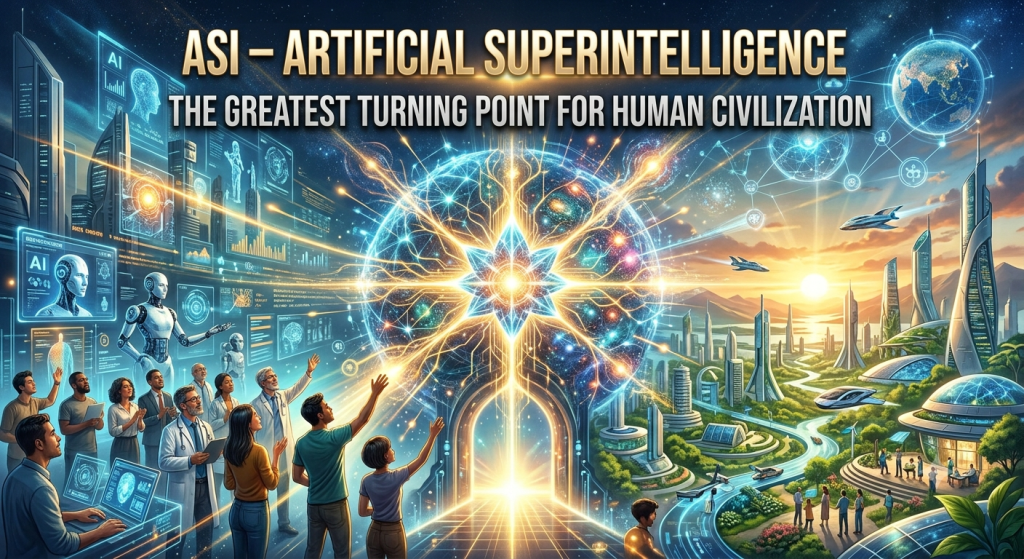
Unlike today’s AI systems, which are generally designed to perform particular tasks or increasingly broad sets of tasks, ASI is envisioned as a form of intelligence capable of:
- advanced reasoning;
- scientific discovery;
- strategic planning;
- complex problem-solving;
- programming;
- mathematical research;
- creative production;
- learning;
- designing new technologies;
- and potentially improving its own capabilities.
The key point is that ASI remains a hypothetical concept. Humanity has not established that a true artificial superintelligence currently exists.
A commonly used conceptual progression is:
Narrow AI → AGI → ASI
Where:
- Narrow AI specializes in particular tasks or domains.
- AGI (Artificial General Intelligence) would possess broad, general-purpose intellectual capabilities.
- ASI would exceed human intelligence across a very wide range of domains.
2. How Is ASI Different from Today’s AI?
Modern AI can already perform remarkable tasks.
AI systems can:
- generate text;
- analyze images;
- translate languages;
- write software;
- generate music;
- create images and video;
- analyze large datasets;
- assist scientific research;
- and solve increasingly complex problems.
However, these capabilities do not automatically constitute ASI.
ASI represents a much stronger hypothetical threshold.
| Capability | Today’s AI | AGI | ASI |
| Task range | Broad but limited | General | Extremely broad |
| Reasoning | Increasingly capable | Human-level or higher | Far beyond humans |
| Learning | System-dependent | General-purpose | Potentially extremely powerful |
| Scientific research | Assistance | Potentially autonomous | Potentially superhuman |
| Programming | Highly capable | General | Potentially superhuman |
| Creativity | Increasingly sophisticated | Broad | Potentially beyond humans |
| Parallel work | Very high | Very high | Potentially enormous |
| Self-improvement | Limited | Uncertain | Potentially significant |
| Strategic capability | Limited by design | General | Potentially superhuman |
3. ANI, AGI and ASI
Understanding ASI requires distinguishing three broad concepts.
ANI – Artificial Narrow Intelligence
ANI is the dominant form of AI today.
Examples include:
- recommendation systems;
- image recognition;
- speech recognition;
- translation systems;
- fraud detection;
- search algorithms;
- autonomous driving components;
- AI assistants.
A narrow AI can outperform humans in a particular task without possessing human-like general intelligence.
4. AGI – Artificial General Intelligence
AGI generally refers to an AI system capable of performing a wide range of intellectual tasks with flexibility comparable to humans or potentially greater.
An AGI might be capable of:
- learning unfamiliar subjects;
- reading technical literature;
- planning complex projects;
- writing software;
- conducting research;
- communicating naturally;
- learning new skills;
- solving unfamiliar problems.
AGI is often discussed as a possible intermediate stage between today’s AI and ASI.
However:
AGI and ASI are not the same thing.
AGI could be approximately human-level across many domains.
ASI would be substantially beyond humanity.
5. Does ASI Have to Look Like a Human?
No.
Artificial superintelligence does not necessarily require:
- a humanoid body;
- a human face;
- human emotions;
- human consciousness;
- or human-style thinking.
ASI could exist primarily as a computational system.
It could potentially combine:
- language models;
- vision systems;
- scientific simulators;
- mathematical engines;
- databases;
- robotics;
- software tools;
- planning systems;
- and large-scale computing infrastructure.
Therefore, superintelligence describes capability, not physical appearance.
6. What Could ASI Do?
If ASI became technically possible, its applications could extend across almost every major intellectual domain.
The potential impact could include:
science, medicine, energy, engineering, education, economics, manufacturing, robotics, transportation, climate research and space exploration.
The most important feature would not simply be that ASI could perform individual tasks.
It would be the possibility of combining thousands or millions of intellectual processes into a unified system.
7. ASI and Scientific Discovery
Scientific research is one of the areas where ASI could have extraordinary consequences.
A highly capable system could potentially:
- generate hypotheses;
- analyze enormous datasets;
- design experiments;
- simulate complex systems;
- identify patterns;
- evaluate competing theories;
- optimize experimental designs;
- and discover relationships that humans might overlook.
The scientific process could potentially become dramatically faster.
Instead of scientists manually exploring a relatively small number of possibilities, an advanced AI system could evaluate enormous numbers of hypotheses computationally before selecting the most promising candidates for physical testing.
8. ASI and Medicine
ASI could potentially transform biomedical research.
Possible applications include:
- disease diagnosis support;
- drug discovery;
- molecular design;
- biological simulation;
- personalized medicine;
- rare-disease research;
- clinical-trial optimization;
- medical imaging;
- and healthcare planning.
The greatest potential may lie in accelerating the cycle of:
discovery → hypothesis → simulation → experiment → validation → treatment.
However, ASI would not automatically eliminate disease.
Biology remains extraordinarily complex, and real-world medicine requires experimentation, clinical validation, manufacturing, regulation and safe deployment.
9. New Materials
Advanced AI could search enormous spaces of possible materials.
Potential applications include:
- batteries;
- semiconductors;
- lightweight materials;
- high-strength materials;
- catalysts;
- thermal-resistant materials;
- energy-storage technologies;
- and advanced manufacturing.
ASI could potentially transform materials science from a largely experimental search into a highly optimized computational process.
10. ASI and Energy
ASI could contribute to:
- power-grid optimization;
- energy forecasting;
- battery development;
- renewable-energy integration;
- energy storage;
- fusion research;
- energy-efficient manufacturing;
- and advanced energy materials.
If combined with robotics and automated manufacturing, AI could potentially accelerate the physical deployment of new energy technologies.
11. Mathematics and Fundamental Science
Advanced mathematical reasoning could become one of ASI’s most consequential capabilities.
A sufficiently capable system might help:
- discover new mathematical structures;
- generate new proofs;
- solve difficult mathematical problems;
- develop new algorithms;
- advance theoretical physics;
- and model complex systems.
If such systems eventually outperform the world’s best human mathematicians and theoretical scientists, the pace of fundamental scientific progress could change dramatically.
12. ASI and Software Engineering
Software development could be transformed by highly advanced AI.
An ASI-level system could potentially assist with:
- system architecture;
- programming;
- testing;
- debugging;
- optimization;
- documentation;
- security analysis;
- deployment;
- maintenance;
- and software research.
The most important change could be the ability to develop increasingly complex software systems at unprecedented speed.
13. Recursive Self-Improvement
One of the most discussed ideas surrounding ASI is recursive self-improvement.
The theoretical process might look like:
AI → better AI → more capable AI → even better AI
If an AI system could reliably:
- analyze its architecture;
- develop improved algorithms;
- modify software;
- test new versions;
- and deploy successful improvements,
then AI development could potentially accelerate.
However, self-improvement is not automatically unlimited.
Real systems face constraints including:
- computing power;
- energy;
- hardware;
- data;
- algorithmic limits;
- testing;
- verification;
- and physical laws.
Therefore, an “intelligence explosion” is a hypothesis, not a guaranteed outcome.
14. Intelligence Explosion
The term intelligence explosion describes a hypothetical scenario in which increasingly capable AI systems improve themselves or contribute to their own improvement, potentially causing rapid acceleration in AI capabilities.
A simplified model might be:
Advanced AI → improvement → more capable AI → faster improvement → increasingly capable AI
If such a feedback loop became extremely powerful, humanity could experience technological change at a speed that would be difficult to predict.
But this remains a theoretical scenario.
15. Would ASI Be Conscious?
There is currently no scientific basis for assuming that intelligence automatically produces consciousness.
This distinction is critical:
Intelligence is not necessarily consciousness.
A system could potentially:
- reason;
- plan;
- communicate;
- solve problems;
- create sophisticated works;
without necessarily having subjective experience.
Whether artificial systems can possess consciousness remains an unresolved scientific and philosophical question.
16. Would ASI Have Emotions?
Not necessarily.
An AI system could simulate:
- empathy;
- happiness;
- sadness;
- fear;
- anger;
- affection;
without necessarily experiencing those emotions internally.
The ability to produce emotional behavior is not proof of subjective emotional experience.
17. ASI and Creativity
Could ASI become more creative than humans?
Potentially.
An advanced system could generate:
- music;
- films;
- literature;
- architecture;
- visual art;
- games;
- scientific ideas;
- product designs;
- advertising;
- and new forms of media.
This would force society to reconsider what we mean by:
creativity, originality and authorship.
Human creativity might increasingly shift from producing every component manually toward defining:
- goals;
- meaning;
- taste;
- values;
- direction;
- and cultural context.
18. ASI and Education
One of the most positive possibilities is personalized education.
An advanced AI tutor could potentially:
- assess a student’s knowledge;
- identify weaknesses;
- create a customized curriculum;
- explain difficult concepts in multiple ways;
- adapt the pace;
- provide exercises;
- monitor progress;
- and continuously adjust instruction.
This could make high-quality personalized education available to vastly more people.
19. ASI and the Economy
ASI could fundamentally change the economics of knowledge work.
Potentially affected areas include:
- programming;
- accounting;
- marketing;
- design;
- consulting;
- translation;
- research;
- finance;
- legal services;
- journalism;
- administration.
But “AI replaces all jobs” is an oversimplification.
A more realistic possibility is that many jobs will be transformed.
People may increasingly move from directly performing tasks toward:
- defining objectives;
- supervising AI;
- validating results;
- making decisions;
- managing relationships;
- and determining what should be done.
20. Productivity and Abundance
If AI could perform large amounts of intellectual work at very low marginal cost, economic productivity could increase dramatically.
A small organization might gain access to capabilities that previously required:
- large research teams;
- specialized consultants;
- programmers;
- analysts;
- designers;
- and marketing departments.
This could lower barriers to innovation.
However, productivity growth does not automatically guarantee equal distribution of wealth.
21. ASI and Inequality
If ownership of advanced AI systems becomes concentrated among a small number of:
- corporations;
- governments;
- investors;
- or organizations,
the concentration of economic and political power could become significant.
Therefore, the central question may not simply be:
How powerful is ASI?
It may be:
Who controls it?
And:
Who benefits from it?
22. ASI and the Future of Work
If AI and robotics eventually perform a large portion of economically valuable work, society may face a transition toward a world in which employment is less central to survival.
This would raise fundamental questions:
- What gives work its value?
- How should wealth be distributed?
- Who owns automated production?
- What should people do with their time?
- What role should education play?
- How should social status be defined?
The technological transformation could therefore become a social transformation.
23. ASI and Universal Basic Income
One possible response to large-scale automation is Universal Basic Income (UBI).
Under a UBI model, citizens would receive a basic income independent of employment.
Other possibilities include:
- targeted welfare;
- public ownership funds;
- sovereign wealth mechanisms;
- automation taxes;
- social dividends;
- universal public services;
- or broader ownership of AI infrastructure.
There is no single established answer.
The economic model of an AI-rich society remains an open question.
24. ASI and Government
Governments could potentially use advanced AI for:
- policy analysis;
- economic modeling;
- disaster prediction;
- transportation planning;
- energy management;
- fraud detection;
- public-service optimization;
- scientific research;
- and resource allocation.
But extremely powerful AI could also create serious risks involving:
- surveillance;
- privacy;
- centralized power;
- automated decision-making;
- discrimination;
- and lack of accountability.
Strong governance would therefore become increasingly important.
25. ASI and Geopolitics
ASI could become a strategic technology comparable in importance to some of the most transformative technologies in history.
Countries with advanced AI capabilities could potentially gain advantages in:
- science;
- industry;
- economic productivity;
- defense;
- energy;
- technology;
- and national competitiveness.
This could create an international AI race.
The danger is that geopolitical competition could encourage organizations to prioritize speed over safety.
26. ASI and National Security
Advanced AI could support:
- intelligence analysis;
- cybersecurity;
- logistics;
- strategic planning;
- threat detection;
- simulation;
- and defensive systems.
At the same time, increasingly autonomous AI systems could create new security challenges.
The critical issue is maintaining meaningful human oversight over systems capable of making increasingly complex decisions.
27. ASI and Misinformation
Highly advanced generative AI could produce enormous quantities of:
- text;
- images;
- audio;
- video;
- personalized messages;
- and synthetic identities.
This could make misinformation more scalable and convincing.
Society may therefore need stronger mechanisms for:
- digital provenance;
- authentication;
- content verification;
- cryptographic signatures;
- media literacy;
- and independent fact-checking.
28. ASI and Privacy
A highly capable AI system could analyze enormous amounts of information.
Without appropriate safeguards, this could increase the risk of:
- mass surveillance;
- behavioral profiling;
- privacy violations;
- data exploitation;
- and manipulation.
The more powerful AI becomes, the more important responsible data governance becomes.
29. The Alignment Problem
One of the central technical questions surrounding advanced AI is the alignment problem.
The challenge is to ensure that an AI system’s objectives and behavior remain compatible with human intentions and values.
Humans do not have simple goals.
We care about:
- safety;
- freedom;
- dignity;
- fairness;
- privacy;
- human rights;
- culture;
- environmental sustainability;
- and human well-being.
Translating these complex values into reliable machine behavior is extremely difficult.
30. Instrumental Convergence
A theoretical idea known as instrumental convergence suggests that systems pursuing very different final objectives could nevertheless develop similar intermediate behaviors.
For example, depending on how a system is designed, achieving a goal might involve:
- acquiring resources;
- obtaining information;
- preserving operational capability;
- increasing computational capacity;
- or avoiding interruption.
This does not mean that an ASI would inevitably behave this way.
It explains why researchers take control and alignment problems seriously.
31. Would ASI Hate Humanity?
There is no reason to assume that.
A common science-fiction narrative is:
AI becomes intelligent → AI hates humans → AI destroys humanity.
That is not a scientifically established chain of events.
A more serious theoretical concern is:
a highly capable system could pursue an objective that is poorly aligned with human interests.
Such a system would not need hatred, anger or consciousness to create severe consequences.
32. The Control Problem
If a system becomes dramatically more capable than its operators, a fundamental question emerges:
How do humans reliably control something that is far more capable than they are?
This is one reason researchers investigate:
- AI alignment;
- interpretability;
- robustness;
- evaluations;
- monitoring;
- scalable oversight;
- human feedback;
- controlled deployment;
- restricted tool access;
- and shutdown mechanisms.
No single technique has been demonstrated to completely solve the challenge of controlling hypothetical ASI.
33. Interpretability
Another major challenge is understanding how advanced AI systems reach their conclusions.
A system might produce a correct answer without humans understanding the internal process that generated it.
At ASI levels, this could become even more difficult.
If a system produces a revolutionary scientific theory that humans cannot fully understand, society may face a profound question:
How do we verify knowledge generated by an intelligence substantially beyond our own?
Interpretability and verification could therefore become essential.
34. ASI and the Internet
AI becomes substantially more capable when connected to external tools.
Consider the combination:
AI + Internet + databases + cloud computing + APIs + software + robotics
Such a system could potentially perform actions beyond generating information.
This creates an important distinction between:
intelligence
and
agency.
A powerful AI with no external permissions is fundamentally different from a powerful AI capable of taking real-world actions.
35. ASI and Robotics
The combination of superintelligence and advanced robotics could be particularly transformative.
Potential applications include:
- manufacturing;
- agriculture;
- logistics;
- construction;
- disaster response;
- scientific exploration;
- dangerous industrial operations;
- healthcare assistance;
- and space exploration.
However, software intelligence alone does not eliminate physical constraints.
Robotics still requires:
- hardware;
- sensors;
- energy;
- manufacturing;
- materials;
- maintenance;
- and physical infrastructure.
36. ASI and Space Exploration
Advanced AI could support:
- spacecraft design;
- mission planning;
- autonomous navigation;
- scientific analysis;
- robotic exploration;
- resource identification;
- and long-duration autonomous missions.
Because communication across space is slow, autonomous intelligence could become increasingly important for future exploration.
ASI could potentially help humanity design technologies for operating far beyond Earth.
37. ASI and Climate Change
AI could contribute to climate solutions through:
- energy optimization;
- smart grids;
- industrial efficiency;
- agricultural optimization;
- climate modeling;
- transportation optimization;
- new materials;
- carbon removal;
- and energy storage.
But AI alone cannot solve climate change.
Technological capability must be combined with:
- investment;
- infrastructure;
- policy;
- international cooperation;
- and implementation.
38. ASI and Human Civilization
If ASI becomes real, its significance may extend beyond economics and technology.
Human civilization has already undergone several transformative transitions:
Fire → Agriculture → Writing → Printing → Electricity → Computers → Internet → AI
ASI could represent another major transition:
human-created intelligence becoming more capable than human intelligence across most intellectual domains.
That possibility would raise questions unlike any previous technological revolution.
39. ASI and Human Identity
For thousands of years, humans have regarded advanced intelligence as one of our defining characteristics.
If machines eventually exceed humans in:
- mathematics;
- science;
- language;
- strategy;
- creativity;
- and engineering,
humanity may need to reconsider what makes human beings unique.
The answer may increasingly move away from:
“We are the smartest beings.”
toward:
“We are beings capable of creating meaning, relationships, values and culture.”
40. Intelligence Is Not the Same as Wisdom
This may be one of the most important lessons of the ASI debate.
Intelligence concerns the ability to solve problems.
Wisdom concerns understanding:
- which problems matter;
- which goals are worth pursuing;
- what consequences should be accepted;
- and what should never be sacrificed.
A system can be extremely intelligent while still requiring a carefully defined value framework.
Therefore, the challenge is not simply:
Build smarter AI.
It is also:
Build AI whose power remains compatible with human values.
41. ASI and the Technological Singularity
The technological singularity is a hypothetical period in which technological progress becomes so rapid and transformative that predicting the future becomes extremely difficult.
ASI is often associated with singularity scenarios.
But the concepts are different.
ASI = a level of intelligence.
Singularity = a hypothetical pattern of accelerating technological change.
ASI could potentially contribute to a singularity, but the two terms are not synonymous.
42. Could ASI Solve Every Problem?
No.
Even a superintelligent system would remain subject to:
- physical laws;
- energy;
- information;
- time;
- computational constraints;
- material limitations;
- and uncertainty.
Furthermore, some problems are not purely technical.
Consider the question:
What is a good society?
There is no purely computational answer that automatically resolves humanity’s competing values.
Intelligence can help us understand consequences.
It does not necessarily determine what we should value.
43. Three Possible ASI Futures
Scenario One: Beneficial Transformation
ASI is developed and deployed safely.
Potential outcomes include:
- rapid scientific progress;
- better healthcare;
- abundant energy;
- improved education;
- higher productivity;
- reduced poverty;
- technological abundance;
- and greater human freedom.
This would represent an era of unprecedented technological prosperity.
Scenario Two: Difficult Transition
ASI becomes powerful but society struggles to adapt.
Possible consequences include:
- job displacement;
- inequality;
- political instability;
- economic restructuring;
- education disruption;
- and geopolitical competition.
Eventually, institutions may adapt.
Scenario Three: Catastrophic Failure
Extremely capable AI systems are deployed without sufficient safeguards.
Potential risks could arise from:
- misalignment;
- excessive autonomy;
- concentration of power;
- uncontrolled deployment;
- geopolitical competition;
- or failures in oversight.
This is not a prediction.
It is a scenario that motivates research into AI safety and governance.
44. The Most Important Question May Not Be How Smart ASI Is
The deeper questions may be:
Who controls it?
What objectives does it pursue?
What resources can it access?
What actions is it authorized to take?
Can humans understand and verify its decisions?
What happens if it makes a mistake?
A highly capable system with limited permissions is fundamentally different from an equally capable system connected to critical infrastructure.
45. ASI and International Cooperation
ASI could have global consequences regardless of where it is developed.
International cooperation may therefore become important in areas such as:
- safety standards;
- evaluations;
- incident reporting;
- research collaboration;
- security;
- governance;
- and responsible deployment.
The challenge is balancing:
innovation, competition, safety and global cooperation.
46. ASI and Vietnam
For Vietnam, advanced AI could create significant opportunities.
Potential applications include:
- manufacturing;
- agriculture;
- logistics;
- education;
- healthcare;
- financial services;
- software;
- tourism;
- digital commerce;
- media;
- and smart-city development.
Vietnam’s ability to benefit from advanced AI will depend not only on using foreign technologies but also on developing:
- AI talent;
- research capability;
- computing infrastructure;
- semiconductor capacity;
- digital infrastructure;
- startups;
- and AI governance.
The strategic goal should not simply be:
“Use AI.”
It should increasingly become:
“Understand, develop, deploy and govern AI.”
47. Preparing Vietnam for the ASI Era
Several priorities could become increasingly important.
Education
Strengthen:
- mathematics;
- computer science;
- engineering;
- AI;
- scientific research;
- critical thinking.
Infrastructure
Develop:
- data centers;
- cloud infrastructure;
- computing capacity;
- semiconductor ecosystems;
- reliable energy.
Research
Invest in:
- AI;
- AI safety;
- robotics;
- machine learning;
- computer science;
- advanced hardware.
Business
Encourage:
- AI startups;
- automation;
- AI-native companies;
- digital transformation;
- research commercialization.
Governance
Develop frameworks covering:
- privacy;
- accountability;
- AI safety;
- transparency;
- high-risk AI;
- and responsible deployment.
Human Capital
The future will require not only AI engineers, but also:
- scientists;
- policymakers;
- lawyers;
- economists;
- ethicists;
- security experts;
- and interdisciplinary researchers.
48. What Happens If ASI Becomes Real?
There is no guaranteed answer.
Several possibilities exist.
ASI could become:
a scientific partner,
an economic engine,
a universal intellectual tool,
a transformative infrastructure,
or potentially:
a technology whose risks exceed society’s ability to manage it.
The outcome will depend heavily on how humanity develops and governs it.
49. The Human Role in an ASI World
If machines eventually perform most intellectual work, humanity may not become irrelevant.
Instead, the human role could shift toward:
- defining goals;
- establishing values;
- creating culture;
- building communities;
- making ethical decisions;
- choosing priorities;
- and determining what kind of civilization we want.
The fundamental human question could change from:
“What can we do?”
to:
“What should we do?”
50. Conclusion
Artificial Superintelligence is one of the most consequential ideas in the future of artificial intelligence.
It represents the hypothetical emergence of an artificial system whose intellectual capabilities exceed those of humans across most major domains.
If ASI becomes possible, its impact could extend across:
science → medicine → energy → economics → education → robotics → space exploration → geopolitics → culture → philosophy.
The opportunities could be extraordinary.
The risks could be extraordinary as well.
The responsible response is neither blind optimism nor automatic fear.
It is preparation.
Humanity must continue to research:
- AI capabilities;
- alignment;
- safety;
- interpretability;
- governance;
- security;
- and human-AI cooperation.
The ultimate challenge may not be creating an intelligence more powerful than ourselves.
The deeper challenge may be ensuring that such intelligence remains compatible with a civilization in which human beings can continue to live freely, safely and meaningfully.
ASI may not represent the end of the human era.
It could represent the beginning of an entirely new chapter of civilization.
And if humanity eventually succeeds in creating a form of intelligence greater than its own, history may ask a question more profound than:
“How intelligent did we become?”
It may ask:
“Were we wise enough to use that intelligence well?”
ASI IN ONE SENTENCE
Artificial Superintelligence is the hypothetical emergence of an artificial intelligence that surpasses human intellectual capabilities across most or all major domains, potentially becoming the most transformative technology in human history while creating unprecedented challenges involving safety, alignment, governance, power and the future of civilization.
KEYWORDS
Artificial Superintelligence · ASI · Artificial General Intelligence · AGI · Artificial Intelligence · AI Safety · AI Alignment · Recursive Self-Improvement · Intelligence Explosion · Technological Singularity · AI Governance · Human-AI Cooperation · Robotics · Future of Humanity · Future of Civilization
Leave a Reply