Marxism–Leninism is one of the most influential and controversial intellectual and political traditions of modern history.
Its intellectual origins lie primarily in the works of Karl Marx and Friedrich Engels, who developed a systematic critique of capitalism and proposed a materialist interpretation of social and historical development. In the early twentieth century, Vladimir Lenin developed Marxist theory further in response to imperialism, monopoly capitalism, revolutionary organization, and the political circumstances of Russia.
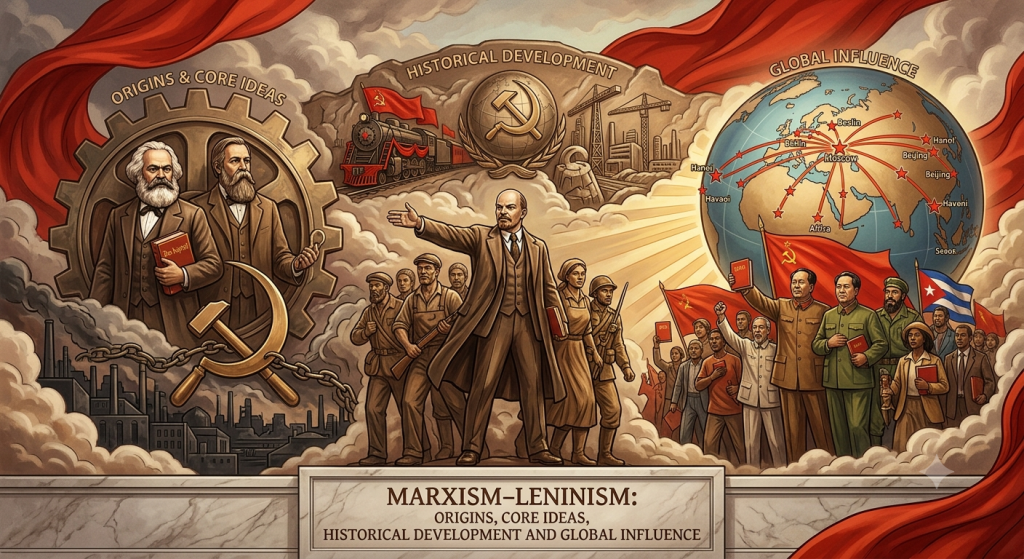
Marxism–Leninism subsequently became the official ideological framework of the Soviet Union and influenced numerous political movements and states across Europe, Asia, Africa, and Latin America.
Understanding Marxism–Leninism therefore requires more than defining it as simply “communism.” It is a broad theoretical tradition involving philosophy, economics, sociology, political theory, revolutionary strategy, and interpretations of history.
1. The Intellectual Origins of Marxism
Karl Marx was born in Prussia in 1818, while Friedrich Engels was born in 1820.
Both lived during a period of profound economic and social transformation. The Industrial Revolution was changing European society. Factories expanded, urban populations increased, traditional forms of production declined, and a new industrial working class emerged.
At the same time, enormous concentrations of wealth developed among industrial and commercial capitalists.
Marx and Engels attempted to understand these transformations systematically.
Their central question was:
Why do societies change, and what forces drive historical development?
Their answer emphasized material conditions, economic relationships, social classes, and conflicts generated by those relationships.
2. Dialectical Materialism
One of the philosophical foundations associated with Marxism–Leninism is dialectical materialism.
Materialism begins from the proposition that material reality exists independently of human consciousness. Human ideas, institutions, and beliefs are therefore understood in relation to real social and material conditions.
The “dialectical” element emphasizes development through contradictions, interaction, transformation, and change.
In simplified terms, Marxist dialectical analysis asks:
- What are the material conditions?
- What contradictions exist within a system?
- Which forces are developing?
- How can quantitative changes produce qualitative changes?
- How does one historical form develop into another?
For Marxists, society is not static. Economic and social systems develop and transform over time.
3. Historical Materialism
Another central concept is historical materialism.
Historical materialism argues that the organization of production and the distribution of economic power play a fundamental role in shaping social institutions and historical development.
Human beings must produce food, shelter, tools, infrastructure, and other necessities.
The way production is organized creates relationships among people.
Marxist theory therefore examines concepts such as:
- productive forces;
- relations of production;
- property;
- labor;
- economic classes;
- political institutions;
- law;
- ideology;
- culture.
Historical materialism does not simply claim that economics mechanically determines everything. Rather, it emphasizes the interaction between economic structures and broader social, political, and cultural processes.
4. Modes of Production
Marxist historical theory often analyzes societies through different modes of production.
These include, in broad historical interpretations:
- Primitive communal societies
- Ancient slave societies
- Feudal societies
- Capitalist societies
- Socialist transition
- Communist society
These categories are analytical models rather than universally accepted descriptions of every society.
The fundamental idea is that different historical societies organize production, property, labor, and social relationships in different ways.
5. Class and Class Struggle
Class struggle is one of the most famous concepts associated with Marxism.
Marx and Engels argued that societies divided into economically opposed classes tend to experience conflicts arising from their different material interests.
Under capitalism, Marx focused particularly on two major classes:
The bourgeoisie
The bourgeoisie are the owners of capital and the means of production.
The proletariat
The proletariat are workers who generally depend upon selling their labor power in order to earn a living.
The relationship between these classes became central to Marx’s analysis of capitalism.
The theory does not mean that every conflict in society can be reduced to two classes. Marxist analysis has also examined peasants, petty bourgeois groups, professionals, intellectuals, managers, and other social strata.
6. Marx’s Critique of Capitalism
Marx’s most extensive economic analysis appears in Capital.
He sought to explain how capitalist production works rather than merely describing capitalism as a system of private property.
Several concepts became especially important.
Commodity
A commodity is a product produced for exchange.
Value
Marx developed a theory concerning the relationship between value, socially necessary labor time, and exchange.
Labor power
Workers sell their capacity to work to employers.
Surplus value
A central concept in Marx’s theory is surplus value.
In simplified terms, Marx argued that workers can create more value during production than the value represented by the wages they receive. The difference becomes a source of surplus for the capitalist.
This mechanism was central to Marx’s explanation of capitalist profit.
7. Capital Accumulation
Capitalism is characterized by continual accumulation.
Capitalists reinvest profits in order to expand production, acquire technology, increase productivity, and compete with other firms.
Competition can therefore encourage:
- technological innovation;
- concentration of capital;
- expansion of markets;
- increased productivity;
- organizational transformation.
Marx believed that these processes also generated contradictions within capitalism.
8. Alienation
Marx also examined alienation, particularly in his early writings.
Workers can become separated from:
- the products they create;
- the process of production;
- their own human potential;
- other people.
Alienation therefore concerns not merely low wages but the broader experience of human beings under particular forms of labor organization.
9. The State
Marxist political theory generally treats the state as deeply connected with social and economic structures.
From a classical Marxist perspective, political institutions do not exist in isolation from class relations.
Different Marxist thinkers developed different interpretations of the state.
Some emphasize the state’s role in maintaining conditions necessary for capitalist property relations. Others examine how states possess relative autonomy and mediate conflicts among different social groups.
Lenin developed the question of the state further in The State and Revolution.
10. Revolution
Marx believed that capitalism generated internal contradictions that could contribute to revolutionary transformation.
However, the precise process of revolution was never presented as a simple mechanical formula.
Historical circumstances, political organization, class consciousness, economic development, and international conditions all matter.
The Marxist revolutionary tradition therefore developed multiple interpretations of how capitalism could be transformed.
11. The Rise of Leninism
Vladimir Lenin was born in 1870 in the Russian Empire.
He became one of the most important revolutionary Marxists of the early twentieth century.
Lenin lived in a very different environment from Marx.
Russia was less industrialized than Britain, Germany, or France and remained under an autocratic imperial government.
Lenin therefore attempted to adapt Marxist theory to the political and economic conditions of Russia.
12. The Vanguard Party
One of Lenin’s most important contributions was his theory of the revolutionary party.
In What Is to Be Done?, Lenin argued that revolutionary politics required a highly organized political movement capable of developing political consciousness, coordinating activity, and maintaining strategic discipline.
This became associated with the concept of a vanguard party.
The idea was that a revolutionary organization could play a leading role in transforming spontaneous social dissatisfaction into organized political action.
13. Democratic Centralism
Leninist organizations became associated with democratic centralism.
In theory, this involved discussion and debate within the organization followed by unified implementation of decisions.
The concept was intended to combine internal deliberation with organizational discipline.
In practice, different communist parties implemented democratic centralism in substantially different ways.
14. Imperialism
Lenin’s analysis of imperialism became another major contribution.
In Imperialism, the Highest Stage of Capitalism, Lenin argued that capitalism had entered a stage characterized by:
- concentration of production;
- monopoly organizations;
- the growing importance of finance capital;
- export of capital;
- international competition among major powers;
- division and redivision of the world.
Lenin connected imperialism with colonialism, international rivalry, and global inequality.
His theory became highly influential among twentieth-century anti-colonial movements.
15. The Russian Revolution
The Russian Revolution of 1917 dramatically changed world history.
The February Revolution overthrew the Russian monarchy.
Later that year, the Bolsheviks, led by Lenin, seized political power during the October Revolution.
The Bolsheviks subsequently attempted to establish a socialist state amid civil war, economic collapse, foreign intervention, and enormous political instability.
The Russian experience became the first major historical attempt to establish a state explicitly based upon Marxist revolutionary principles.
16. The Soviet Union
In 1922, the Union of Soviet Socialist Republics, commonly known as the Soviet Union, was established.
After Lenin’s death in 1924, political struggles occurred over the future direction of the Soviet state.
Joseph Stalin eventually became the dominant leader.
During Stalin’s rule, the Soviet system underwent rapid industrialization, collectivization of agriculture, central economic planning, and extensive political repression.
The Soviet experience profoundly shaped the subsequent meaning of Marxism–Leninism.
17. What Is Marxism–Leninism?
The term Marxism–Leninism became particularly important as the official ideological formulation of the Soviet Communist Party under Stalin.
It presented itself as a systematic continuation and development of Marxism and Leninism.
Its major themes included:
- dialectical and historical materialism;
- class struggle;
- proletarian political leadership;
- revolutionary organization;
- socialism;
- proletarian internationalism;
- the socialist state;
- imperialism;
- the transition from capitalism to socialism and ultimately communism.
Different communist parties interpreted Marxism–Leninism differently.
18. The Dictatorship of the Proletariat
One of the most misunderstood concepts is the dictatorship of the proletariat.
In classical Marxist terminology, “dictatorship” did not necessarily mean personal dictatorship.
It referred to a political form in which the working class would hold political power during the transition from capitalism toward communism.
Lenin developed this concept as part of his theory of revolutionary transition.
Critics, however, argue that historical communist states often developed highly centralized political systems that restricted political pluralism and civil liberties.
19. Socialism
In Marxist–Leninist theory, socialism represents a transitional stage between capitalism and full communism.
The exact definition varies among Marxist traditions.
Generally, socialism is associated with:
- social ownership of major means of production;
- planned economic development;
- reduction of class inequalities;
- political power associated with the working class;
- restructuring of economic relations.
In historical practice, socialist states employed different combinations of state ownership, collective ownership, markets, planning, and private economic activity.
20. Communism
Communism, in classical Marxist theory, represents a future society beyond class divisions.
Marx described a society in which social antagonisms based on class would disappear and production would be organized around human needs and collective social development.
The famous principle often associated with this vision is:
“From each according to his ability, to each according to his needs.”
In this theoretical conception, the state as a coercive political institution would eventually cease to be necessary.
This theoretical communist society has never been fully achieved in historical practice.
21. The Role of the Economy
Marxism–Leninism places strong emphasis on economic organization.
A socialist economy traditionally seeks to replace private control over major productive resources with social or state ownership.
Central planning became particularly important in the Soviet model.
Governments established production targets, allocated resources, controlled prices, and directed investment.
The system achieved major industrial transformations but also experienced serious problems, including shortages, bureaucratic inefficiency, weak incentives, and difficulties in allocating resources efficiently.
22. Marxism–Leninism and Culture
Marxist–Leninist theory also addresses culture and ideology.
From this perspective, ideas are influenced by social relations and material conditions.
Literature, education, journalism, religion, philosophy, art, and political discourse can therefore become important areas of ideological struggle.
This contributed to the development of concepts such as:
- socialist culture;
- socialist realism;
- ideological education;
- class consciousness;
- revolutionary propaganda.
At the same time, the historical use of ideological control in communist states has generated extensive criticism concerning censorship and freedom of expression.
23. Religion
Classical Marxism developed a critical view of religion.
Marx famously described religion as an expression of human suffering and social alienation.
Marxist analysis generally treats religion as connected to historical and social circumstances rather than as an independent explanation of society.
Communist governments adopted different policies toward religion.
Some promoted secularism and restricted religious institutions, while others later adopted more pragmatic policies.
24. Marxism–Leninism and National Liberation
During the twentieth century, Marxism–Leninism became closely connected with anti-colonial movements.
Revolutionaries in Asia, Africa, Latin America, and elsewhere drew upon Marxist and Leninist concepts to analyze colonialism, imperialism, class inequality, and national independence.
Lenin’s theory of imperialism was particularly influential in this context.
The result was an important historical connection between socialist politics and national liberation.
25. Marxism–Leninism in China
The Chinese Communist Revolution produced another major development.
Mao Zedong adapted Marxism–Leninism to China’s predominantly agrarian society.
This approach emphasized:
- the peasantry;
- revolutionary rural organization;
- protracted revolutionary struggle;
- mass mobilization;
- the political role of the Communist Party.
After 1949, the People’s Republic of China established a socialist political and economic system.
Later, China introduced extensive economic reforms and market mechanisms while maintaining Communist Party political leadership.
26. Marxism–Leninism in Vietnam
Vietnamese revolutionary thought was strongly influenced by Marxism–Leninism through the political work of Ho Chi Minh and the Vietnamese revolutionary movement.
Marxism–Leninism became an important ideological foundation of the Vietnamese revolutionary state.
Vietnam’s historical experience combined national independence, social revolution, anti-colonial struggle, war, reunification, and socialist construction.
Beginning in 1986, the Đổi Mới reforms introduced major economic changes.
Vietnam subsequently developed a mixed economy incorporating markets, private enterprise, foreign investment, and state ownership while retaining the political leadership of the Communist Party of Vietnam.
27. Marxism–Leninism and the Cold War
After the Second World War, Marxism–Leninism became one of the central ideological foundations of the Soviet bloc.
The world increasingly divided into competing political and economic systems.
The United States and its allies generally supported liberal capitalism and political pluralism, while the Soviet Union and its allies promoted socialist systems.
This rivalry became known as the Cold War.
It involved:
- military competition;
- nuclear weapons;
- ideological conflict;
- technological competition;
- economic rivalry;
- proxy wars;
- competition for influence in developing countries.
28. Major Achievements Claimed by Marxist States
Supporters of Marxist–Leninist systems point to several historical achievements.
These include rapid industrialization in some countries, mass literacy campaigns, expansion of education, development of public health systems, women’s participation in employment and politics, scientific achievements, and the defeat of Nazi Germany alongside other Allied forces.
The Soviet Union also became a major scientific and technological power and launched Sputnik 1, the first artificial satellite, in 1957.
The Soviet space program later sent Yuri Gagarin into orbit in 1961.
29. Major Criticisms
Marxism–Leninism has also faced extensive criticism.
Critics have highlighted:
- political repression;
- censorship;
- restrictions on political pluralism;
- concentration of political power;
- secret-police systems;
- forced collectivization;
- famine;
- labor camps;
- economic inefficiency;
- shortages;
- suppression of dissent.
The historical record varies considerably between countries and periods, and historians continue to debate the causes, scale, and interpretation of these events.
30. Marxism–Leninism and Democracy
The relationship between Marxism–Leninism and democracy is complex.
Liberal democratic systems generally emphasize:
- competitive elections;
- separation of powers;
- political pluralism;
- independent institutions;
- civil liberties.
Traditional Marxist–Leninist systems instead emphasize:
- class leadership;
- political unity;
- party organization;
- collective social goals;
- the revolutionary role of the Communist Party.
Supporters argue that liberal democracy can conceal economic inequalities behind formal political equality.
Critics argue that one-party systems can suppress individual freedoms and prevent peaceful political competition.
31. The Collapse of the Soviet Union
The Soviet Union dissolved in 1991.
Its collapse represented one of the greatest geopolitical transformations of the twentieth century.
The event generated major debates about Marxism–Leninism.
Some interpreted the collapse as evidence of fundamental weaknesses in centrally planned socialist systems.
Others argued that the Soviet experience should not be equated with Marx’s theoretical conception of communism and pointed instead to specific historical, political, economic, and institutional factors.
32. Marxism After the Soviet Union
The end of the Soviet Union did not eliminate Marxist thought.
Marxist theory continued to influence:
- political philosophy;
- economics;
- sociology;
- history;
- cultural studies;
- labor studies;
- international relations;
- theories of inequality;
- critiques of globalization.
Many contemporary scholars use Marx’s concepts without supporting Leninist revolutionary politics.
This distinction is important.
Marxism, Leninism, Marxism–Leninism, Western Marxism, democratic socialism, and social democracy are not identical traditions.
33. Marxism and Modern Capitalism
Some Marxist concepts remain influential in discussions of modern capitalism.
These include:
- wealth concentration;
- labor exploitation;
- capital accumulation;
- economic inequality;
- monopoly power;
- financialization;
- globalization;
- automation;
- technological unemployment.
The development of artificial intelligence and automation has also revived questions about the future of work.
If machines can perform an increasing number of economically valuable tasks, questions about ownership, labor, income distribution, and social welfare become increasingly important.
These questions can be analyzed through Marxist theory even by people who do not identify as Marxists.
34. Marxism–Leninism and Artificial Intelligence
The rise of artificial intelligence creates new theoretical questions.
Who owns AI systems?
Who owns the computing infrastructure?
Who controls data?
Who receives the economic gains generated by automation?
Will AI reduce human labor or transform it?
Will technological wealth become concentrated among a small number of corporations?
These questions resemble some of the broader concerns Marx raised about ownership, capital accumulation, and labor.
However, modern digital capitalism also introduces phenomena that Marx could not have directly analyzed, including platforms, algorithms, cloud computing, large-scale data economies, and generative AI.
35. The Continuing Debate
The intellectual legacy of Marxism–Leninism remains deeply contested.
Its supporters may view it as a framework for understanding exploitation, imperialism, class inequality, and structural power.
Its critics emphasize authoritarianism, political repression, economic problems, and historical tragedies associated with communist governments.
A serious study therefore requires distinguishing between:
- Marx’s theoretical writings;
- Engels’ contributions;
- Lenin’s revolutionary theory;
- Soviet Marxism–Leninism;
- Stalinism;
- Maoism;
- Vietnamese Marxism–Leninism;
- other national interpretations;
- contemporary academic Marxism.
Treating all of these as exactly the same would oversimplify a highly complex intellectual history.
36. Why Marxism–Leninism Matters
Whether one agrees with Marxism–Leninism or rejects it, its historical importance is undeniable.
It influenced the political organization of hundreds of millions of people and shaped the twentieth century alongside liberalism, nationalism, capitalism, fascism, social democracy, and other political traditions.
Its ideas influenced revolutions, governments, labor movements, anti-colonial struggles, international relations, economics, literature, philosophy, and education.
Few political theories have had such a profound impact on modern history.
Conclusion
Marxism–Leninism emerged from the intellectual tradition created by Karl Marx and Friedrich Engels and was developed further by Vladimir Lenin under the conditions of revolutionary Russia.
At its core are several interconnected ideas:
materialism, historical development, class struggle, critique of capitalism, revolutionary organization, socialism, and the transition toward communism.
Its historical implementation produced both significant achievements and profound human costs, depending on the country, period, and historical circumstances examined.
The Soviet Union’s collapse demonstrated the limitations of one particular historical model, but it did not erase Marxist thought from intellectual life.
Today, Marxism remains an important framework for studying capitalism, inequality, labor, ownership, globalization, and technological transformation. Leninism remains historically significant for understanding revolutionary organization and twentieth-century communist politics.
Ultimately, studying Marxism–Leninism is not simply an exercise in accepting or rejecting an ideology.
It is an opportunity to understand one of the most consequential intellectual and political traditions in modern world history—and to examine critically both its theoretical ambitions and its historical consequences.
Leave a Reply