From imitating intelligence to building a new architecture of cognition
There is a question becoming increasingly important in the age of artificial intelligence:
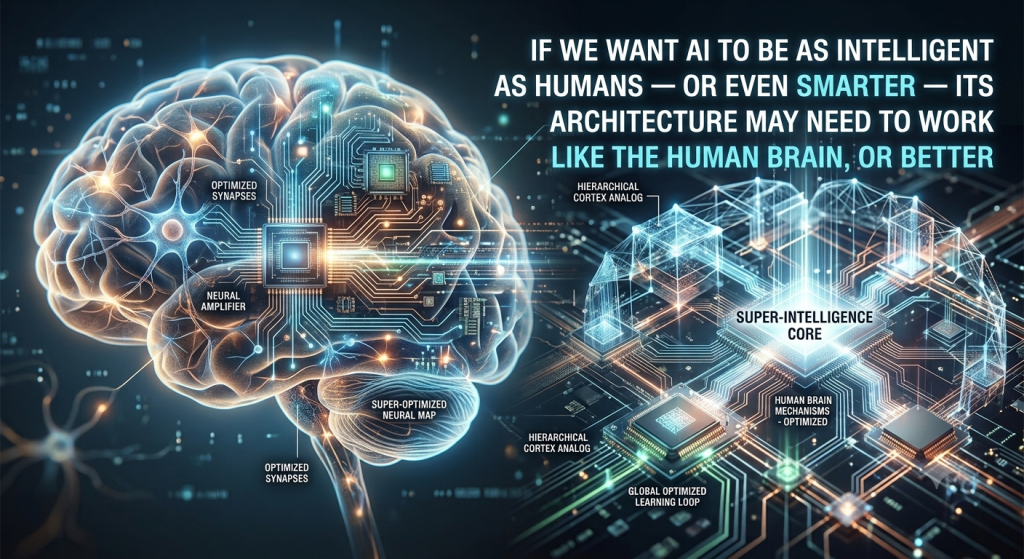
If we want to create AI with intelligence comparable to humans — or even beyond humans — is it enough to give machines more data, more computing power, and larger models?
Perhaps not.
Humans are not intelligent simply because the brain contains billions of neurons. What matters even more is how those neurons connect, learn, remember, predict, focus attention, form concepts, plan actions, and continuously interact with the world.
This leads to a compelling possibility:
To build truly general artificial intelligence, we may need systems based on the core principles of the human brain — or entirely new architectures that achieve the same functions more efficiently than biology.
This could become one of the defining challenges of the next era of AI.
1. The Human Brain Does More Than “Compute”
Traditional computers are extraordinarily good at clearly defined problems.
Input data.
Perform calculations.
Produce an output.
Human intelligence is fundamentally more complex.
A child can see a cup only a few times and quickly develop the concept:
“This is an object that can contain liquid.”
The child does not need millions of photographs of cups.
Humans can learn from very few examples, use previous experience to solve unfamiliar problems, understand context, reason with incomplete information, and continuously adjust their behavior.
This distinction is crucial.
Intelligence is not simply the amount of information stored. It is also the mechanism through which information is organized, connected, interpreted, and used.
2. The Brain Can Be Viewed as a Prediction System
One fascinating way to think about the brain is as a prediction engine.
The brain constantly receives signals from the world:
- images;
- sounds;
- sensations;
- language;
- bodily states;
- memories;
- other people’s actions.
But the brain does not simply record everything that happens.
It continuously asks:
What is likely to happen next?
When we see someone holding a cup and raising it toward their mouth, the brain can predict that they are probably about to drink.
When we hear an incomplete sentence, the brain predicts what words might come next.
When we see a road, the brain predicts how vehicles may move through it.
In other words:
The brain does not merely react to the world. It constructs an internal model of the world and continuously updates that model.
Future AI systems may need to develop this capability far more deeply.
3. Memory May Be Just as Important as Reasoning
An AI system capable of processing information extremely quickly but lacking effective memory would face fundamental limitations.
Human memory is not a single mechanism.
Some information remains active for only a few seconds.
Other information can remain accessible for decades.
Some experiences may no longer be consciously remembered but can still influence future behavior.
Most importantly:
Human memories do not exist entirely in isolation.
A new experience can become connected to hundreds or thousands of previous experiences.
This is one of the ways human knowledge develops.
Future AI may therefore require multiple layers of memory:
Immediate memory → working memory → long-term memory → conceptual knowledge → experience → world model.
Such a system would not simply answer based on what it has just seen. It could use its accumulated history of learning to make decisions.
4. Continuous Learning Is a Major Challenge
Humans learn throughout their lives.
Learning something new today does not require rebuilding the entire brain from scratch.
Yet many current AI systems still depend heavily on large-scale training phases.
This raises an important question:
Can a system truly be considered intelligent if it cannot continuously adapt to a changing world?
Future AI may need a continuous loop:
Observe → experience → remember → reason → act → receive feedback → adapt → continue learning.
This is closer to a continuously operating cognitive system than a model that simply receives an input and generates an output.
5. The Human Brain Is Remarkably Energy Efficient
One of the most remarkable facts about the brain is that it operates with relatively low energy consumption compared with the enormous computing infrastructure used to train today’s most powerful AI systems.
The brain contains tens of billions of neurons and an extraordinary number of connections, yet it does not operate like a conventional CPU.
It relies on mechanisms such as:
- massive parallel processing;
- event-driven signaling;
- dynamic connections;
- selective attention;
- prioritization of important information;
- suppression of unnecessary signals.
This suggests an important principle:
More powerful AI does not necessarily have to mean more energy-hungry AI.
A more efficient intelligence could be one that knows:
When deep computation is necessary, when a rapid response is sufficient, when memory should be retrieved, and when information can simply be ignored.
6. Attention May Be Only the Beginning
Modern AI has demonstrated the power of attention mechanisms.
Attention allows a model to determine which parts of information are most relevant to what it is currently processing.
But future systems may require much more sophisticated forms of attention.
Humans do not consciously process everything with equal priority.
We select.
We prioritize.
We redirect attention according to our goals.
Imagine someone searching for a lost key in a room. The brain does not assign equal importance to every object.
It focuses on places where the key is most likely to be found.
This suggests a deeper principle:
Intelligence is not only the ability to process more information. It is also the ability to know which information does not need to be processed.
7. AI May Need a World Model
This could become one of the most important components of future AI.
A person does not merely know:
“The ball falls.”
They also understand that:
- the ball has mass;
- gravity affects it;
- throwing it harder can change its trajectory;
- obstacles can alter its path;
- another person’s actions can change what happens next.
Humans construct an internal model of the world.
An advanced AI system may need something similar.
Instead of simply predicting:
“What word comes next?”
it could increasingly reason:
“If I perform action A, how is the world likely to change?”
That represents a transition from predicting information to simulating possible worlds.
8. From Feedback to Self-Learning
Humans do not learn only from books.
We learn from mistakes.
A child touches something hot.
It feels pain.
The brain records:
action → result → consequence → behavioral change.
This is an extraordinarily powerful learning mechanism.
Future AI could require a similar loop:
Goal → action → observe outcome → evaluate → update the model → choose the next action.
Combined with long-term memory and a world model, AI would not merely “answer questions.”
It could learn through experience.
9. But the Goal Does Not Have to Be Copying the Brain
This is an important distinction.
If humans wanted to build an airplane, we would not need to construct a mechanical bird containing feathers, muscles, and bones identical to those of an actual bird.
We studied the principles of flight.
Then we created a different system that could perform the same fundamental function — and in some ways outperform birds.
AI may follow a similar path.
The human brain is the product of evolution.
It possesses extraordinary capabilities, but it also has limitations:
- it becomes tired;
- it forgets;
- it is vulnerable to bias;
- emotions can influence decisions;
- mathematical computation is limited;
- some forms of information processing are much slower than machines.
Therefore, the ultimate objective may not be:
“Build an artificial brain identical to the human brain.”
Instead, it may be:
Identify the principles that produce intelligence and build an architecture capable of implementing those principles more effectively.
10. What Could an AI Architecture Beyond the Human Brain Look Like?
Imagine a system composed of multiple layers.
Layer 1 — Perception
Seeing, hearing, reading, and sensing the environment.
Layer 2 — Memory
Storing important experiences and building relationships between them.
Layer 3 — World Model
Developing an understanding of people, physical reality, society, time, and the environment.
Layer 4 — Reasoning
Analyzing causes, consequences, uncertainty, and possible outcomes.
Layer 5 — Planning
Defining objectives and identifying optimal sequences of actions.
Layer 6 — Simulation
Testing multiple possible scenarios internally before taking action.
Layer 7 — Action
Interacting with the physical or digital world.
Layer 8 — Feedback
Evaluating what happened.
Layer 9 — Self-Improvement
Updating knowledge, strategies, and internal models.
When these layers operate in a continuous loop, we may move closer to a system with autonomous cognitive capabilities.
11. This May Be the Difference Between Today’s AI and AGI
Today’s AI systems are already extraordinarily capable.
They can:
- write;
- program;
- translate;
- analyze data;
- generate images;
- generate audio;
- solve many complex problems.
But AGI — Artificial General Intelligence — implies something broader.
A true AGI system would need broad adaptability, the ability to learn unfamiliar tasks, transfer knowledge between domains, and solve problems it was not explicitly trained to solve.
Achieving this may require more than simply increasing scale.
It may require a fundamental change in cognitive architecture.
12. Superintelligence May Not Think Like Humans
If AI eventually surpasses human intelligence, it does not necessarily have to think like a human.
The opposite may be more likely.
Human intelligence evolved to survive in a biological environment.
An artificial intelligence system could be designed for an entirely different environment.
It might:
- possess enormous persistent memory;
- process millions of information streams;
- run many reasoning processes in parallel;
- simulate millions of scenarios;
- interact with millions of digital systems;
- learn from enormous amounts of data;
- operate continuously without sleep.
If these capabilities were combined with cognitive principles inspired by the human brain, we could potentially create a form of intelligence no longer constrained by biological limitations.
13. “Brain-Inspired” and “Beyond-the-Brain” Could Be Parallel Paths
The future may not follow a single direction.
One path is neuromorphic AI — computing systems inspired by the structure and operation of biological nervous systems.
Another path is the development of entirely new computational architectures.
The most powerful direction may ultimately be a combination:
Neural principles + machine learning + long-term memory + world models + reasoning + planning + continuous learning.
At that point, we would no longer be building merely a “large language model.”
We would be building an artificial cognitive system.
14. The Real Competition May Be About Architecture
During the early era of AI, the central question was:
Who has more data?
Then:
Who has more GPUs?
Then:
Who has the larger model?
In the future, the question may become:
Who has the more efficient architecture for intelligence?
A relatively small system that can learn, remember, reason, plan, and improve itself could ultimately be more valuable than a gigantic system that depends primarily on scale.
This is why research into AI architecture may become just as important as increasing computing power.
15. From “AI That Knows” to “AI That Understands”
Perhaps this is the deepest boundary.
A system can possess enormous amounts of information without necessarily having a deep model of the world.
Humans do not merely remember:
“Fire is hot.”
We understand a chain of relationships:
fire → heat → danger → injury → reaction → behavioral change.
This is a network of causal relationships.
If AI can construct similar networks at enormous scale, while continuously testing and updating them through experience, its reasoning capabilities could increase dramatically.
16. Intelligence May Begin With a Simple but Powerful Loop
Perhaps intelligence is not a mysterious phenomenon.
It may emerge from a powerful continuous cycle:
Observe → build a model → predict → act → receive feedback → remember → update → predict better.
Humans execute this loop through biological brains.
AI could execute it through silicon, neuromorphic hardware, or architectures we have not yet invented.
And if machines can execute this loop faster, across more domains, and more efficiently than humans, a new form of intelligence could emerge.
Conclusion: We May Not Need to Build an “Artificial Brain” — We May Need to Build a Better Mechanism for Intelligence
If we want AI to reach human-level intelligence, increasing data, computing power, and model size will likely remain important.
But that may not be the final destination.
Human intelligence emerges from a system capable of perception, memory, prediction, learning, reasoning, planning, and continuous adaptation.
Therefore, if we want to build truly intelligent AI, we may need to understand those principles at a much deeper level.
But the ultimate goal does not necessarily have to be copying the human brain.
The human brain may be a reference design — not the final design.
Just as an airplane does not need to have wings identical to a bird’s wings in order to fly, an advanced artificial intelligence does not necessarily need to think exactly like a human to become intelligent.
The future may create something entirely new:
An intelligence inspired by the human brain, but no longer limited by the human brain.
And then the biggest question facing humanity may no longer be:
“How can we make machines as intelligent as humans?”
It may become:
“If intelligence is no longer constrained by biology, how powerful could a new form of intelligence become?”
That may be one of the defining questions of the 21st century.
Leave a Reply